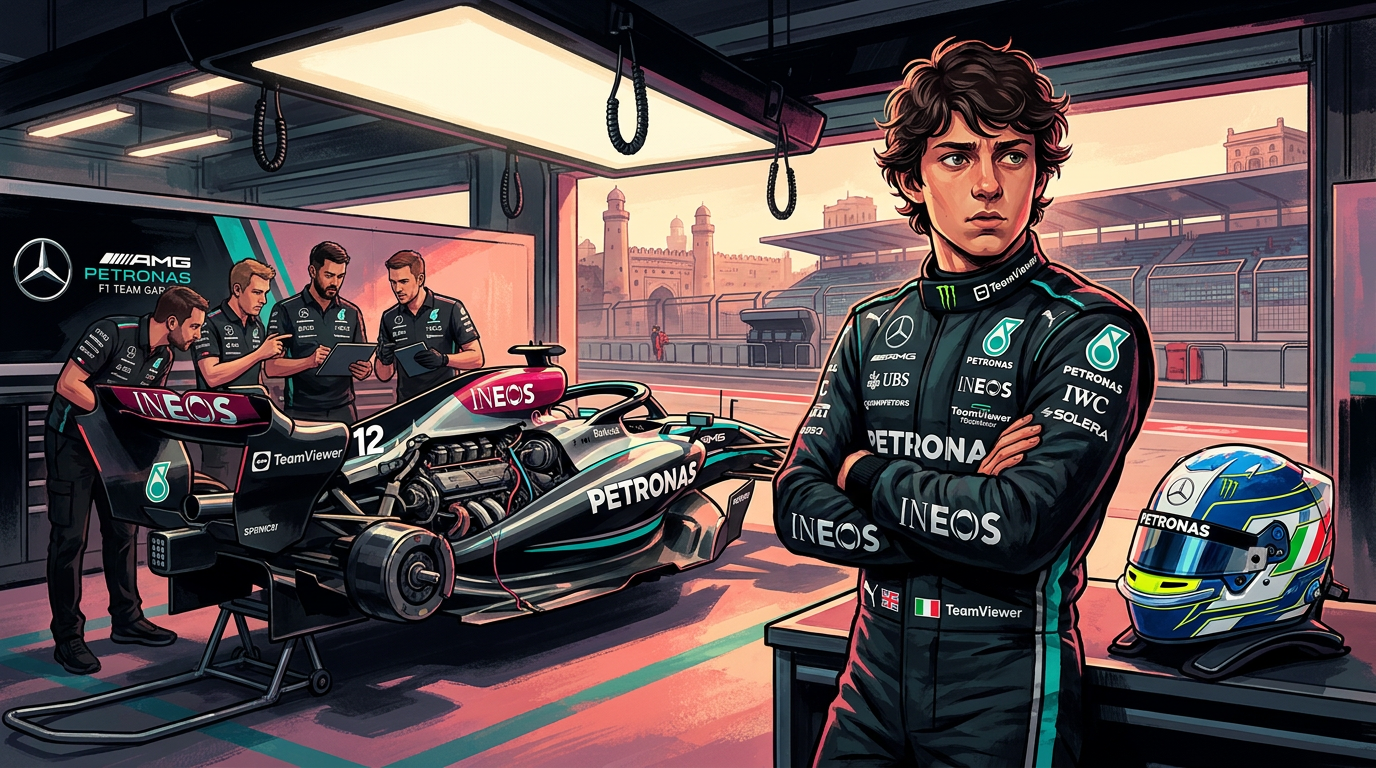

Kimi Antonelli heads to Baku with eight wins from the first 14 grands prix of 2026, making him the benchmark for Formula 1’s most unusual street-circuit test.
The Italian holds an 81-point lead over Mercedes teammate George Russell, 292 to 211, before the Azerbaijan Grand Prix on Saturday, September 26. Ferrari’s Lewis Hamilton is third with 191, followed by Lando Norris on 186 and Charles Leclerc on 167.
The verdict is simple. Mercedes enters as the favorite, but Baku rarely respects the form book.
A Saturday race changes the rhythm
The Formula 1 Qatar Airways Azerbaijan Grand Prix 2026, round 15, runs from Thursday, September 24, through Saturday, September 26. It follows the September 11 to 13 Spanish Grand Prix and precedes the October 2 to 4 Bahrain Grand Prix in Malaysia.
Track action starts Thursday, with practice at 12:30 and 16:00 local time. Final practice begins at 12:30 Friday, then qualifying follows at 16:00. Saturday’s 51-lap race for a total of 306 kilometers starts at 15:00.
The schedule matters.
Teams give up the usual Friday-to-Sunday routine, and drivers must find qualifying intensity one day sooner. A problem during Thursday practice leaves less time to recover. Grip develops quickly on this temporary circuit, while confidence dictates how closely drivers challenge the walls, so the disruption suits organized teams arriving with a stable baseline.
Mercedes has provided the strongest baseline throughout the season. Its 503 constructors’ points leave it comfortably ahead of Ferrari on 358 and McLaren on 306.
Baku combines conflicting circuit demands
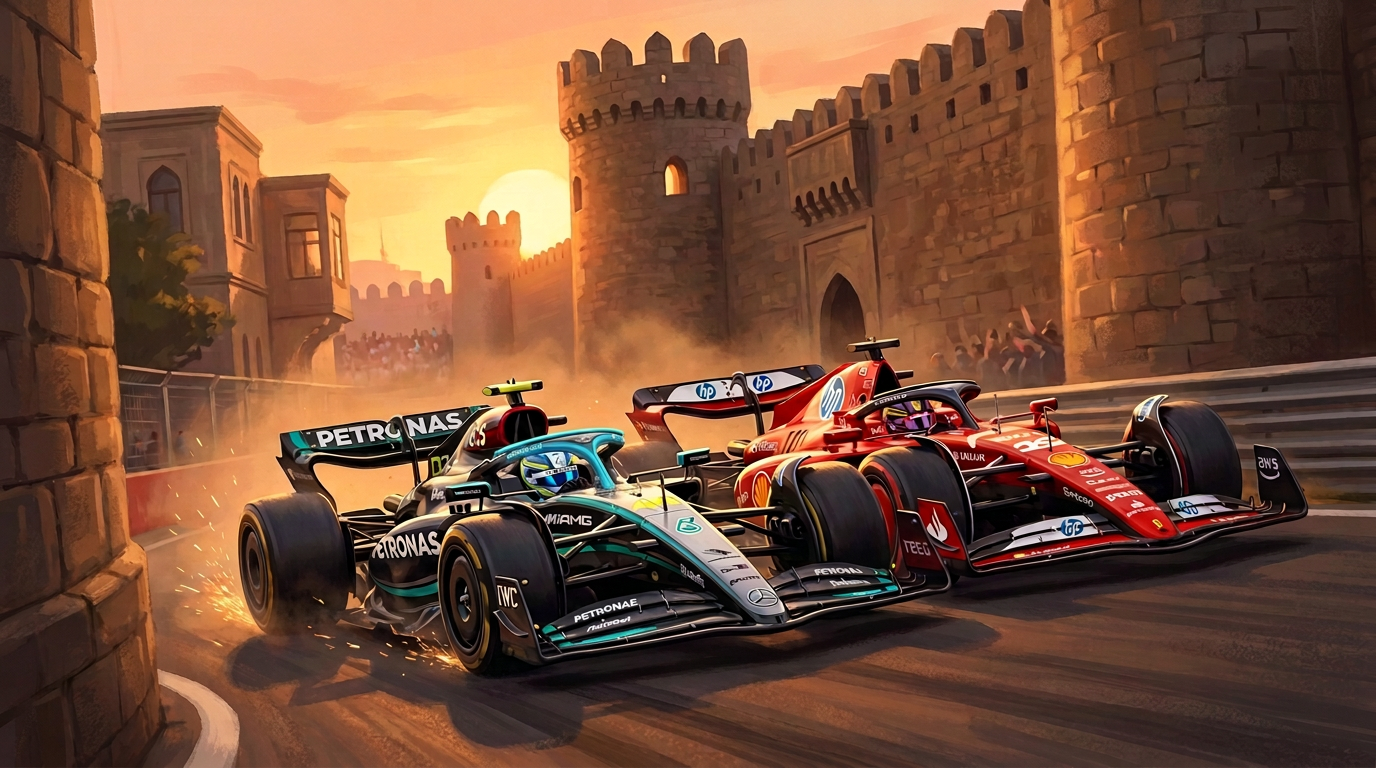
Baku City Circuit is a fast, counterclockwise temporary track running through the capital and beside the Caspian Sea. Contrasts define it. The old-town section climbs between unforgiving walls, while the long seafront stretch favors low drag and straight-line efficiency.
That creates a difficult compromise. Remove too much downforce and the car becomes troublesome through the tight corners. Add wing to improve stability and it becomes exposed in the slipstream on the flat-out section.
The prime passing opportunity follows that long run, where a clean exit, battery deployment and the tow can set up an attack under braking. Cars can also stay close enough along the same straight to threaten later, which makes track position valuable but not decisive.
Baku’s history supports a clear verdict: a driver cannot control the race from pole as though this were Monaco. The long straight keeps pursuing cars in contention, while contact with the walls can reset the order through a safety car or virtual safety car.
History gives reputations little protection
Formula 1 has reached 10 years of racing in Baku, starting with the city’s first championship event in 2016. Minor errors, tire failures and restart mistakes repeatedly become major swings here. Max Verstappen and Sergio Perez have each two wins at the Baku circuit, with Daniel Ricciardo, Nico Rosberg, Vallteri Bottas, Lewis Hamilton and Oscar Piastri sharing one win a piece in the past decade. Red Bull Racing has been the most successful team to date at this track with 5 wins total including last year's win by Verstappen.
That history rewards adaptability rather than tidy record-book forecasts. Antonelli has won in China, Japan, Miami, Canada, Monaco, Belgium, Italy and Spain this year. Russell claimed Australia and Austria. Hamilton won at Barcelona-Catalunya, Leclerc took Britain, and Norris prevailed in Hungary and the Netherlands.
Five winners from 14 races suggests competition. Antonelli’s eight victories tell a different story.
Strategy begins with patience
Baku tempts teams to respond to every incident. That can be costly. In a conventional dry race, a one-stop plan can work because track position carries weight and a long opening stint preserves options, but teams still need enough tire life to handle a late interruption.
Stopping early can provide clean air or produce an undercut. It can also strand a driver on worn tires if a later safety car hands rivals a cheaper pit stop. A longer first stint brings the reverse danger, particularly when a competitor uses fresher rubber to launch an attack before the long straight.
Flexibility matters most. Leaders should conserve tire life in the early stages, while midfield teams have an incentive to divide their strategies and bet on the timing of interruptions. Pit crews face added pressure because one slow service can return a car to traffic, with the old-town section limiting any immediate recovery.
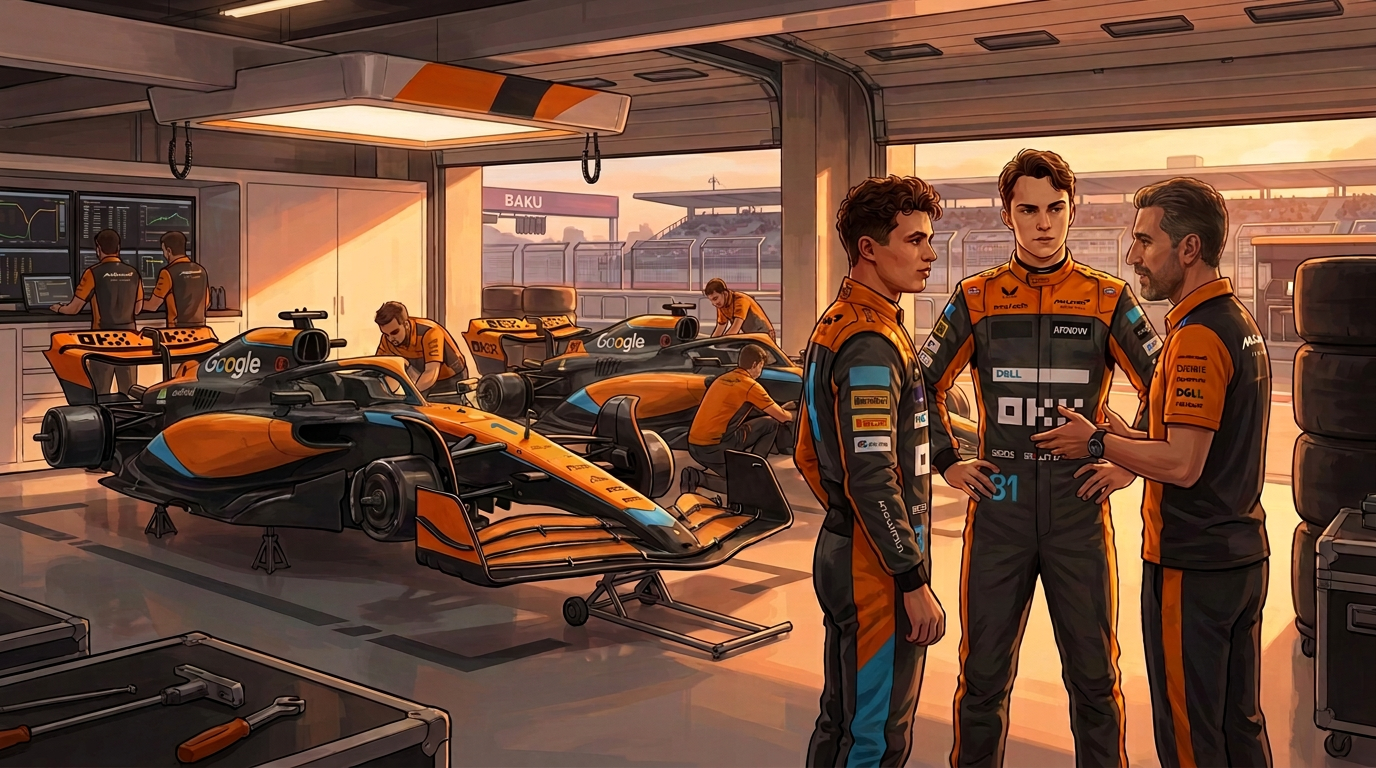
McLaren has predicted an unconfirmed four-way fight and will bring further upgrades. Williams also has an FW48 update package drawing attention ahead of the weekend. Those developments increase the value of Thursday’s longer runs, especially with the first two sessions starting at 12:30 and 16:00.
Antonelli’s real opponent is Baku itself
Antonelli won the September 13 Spanish Grand Prix ahead of Max Verstappen and Norris. His championship standing no longer demands risk every week. With an 81-point advantage over Russell, he can settle for a podium instead of attempting a marginal pass alongside concrete.
Restraint will be his main test.
Russell must cut the deficit, while Hamilton, Norris and Leclerc require a significant shift in form. Verstappen is sixth with 145 points, and Red Bull has acknowledged a car degradation problem across race weekends that cannot be fully cured with its 2026 machine. Mercedes can approach Saturday with two legitimate winners and a 145-point constructors’ lead over Ferrari.
Baku can create chaos, but chaos offers no strategic plan. Mercedes has the clearest path to control: qualify both cars near the front, keep them away from midfield incidents and offset one driver’s pit window from the other.
The first indication comes Thursday at 12:30 local time, when Antonelli starts discovering how much caution an 81-point lead allows between Baku’s walls.