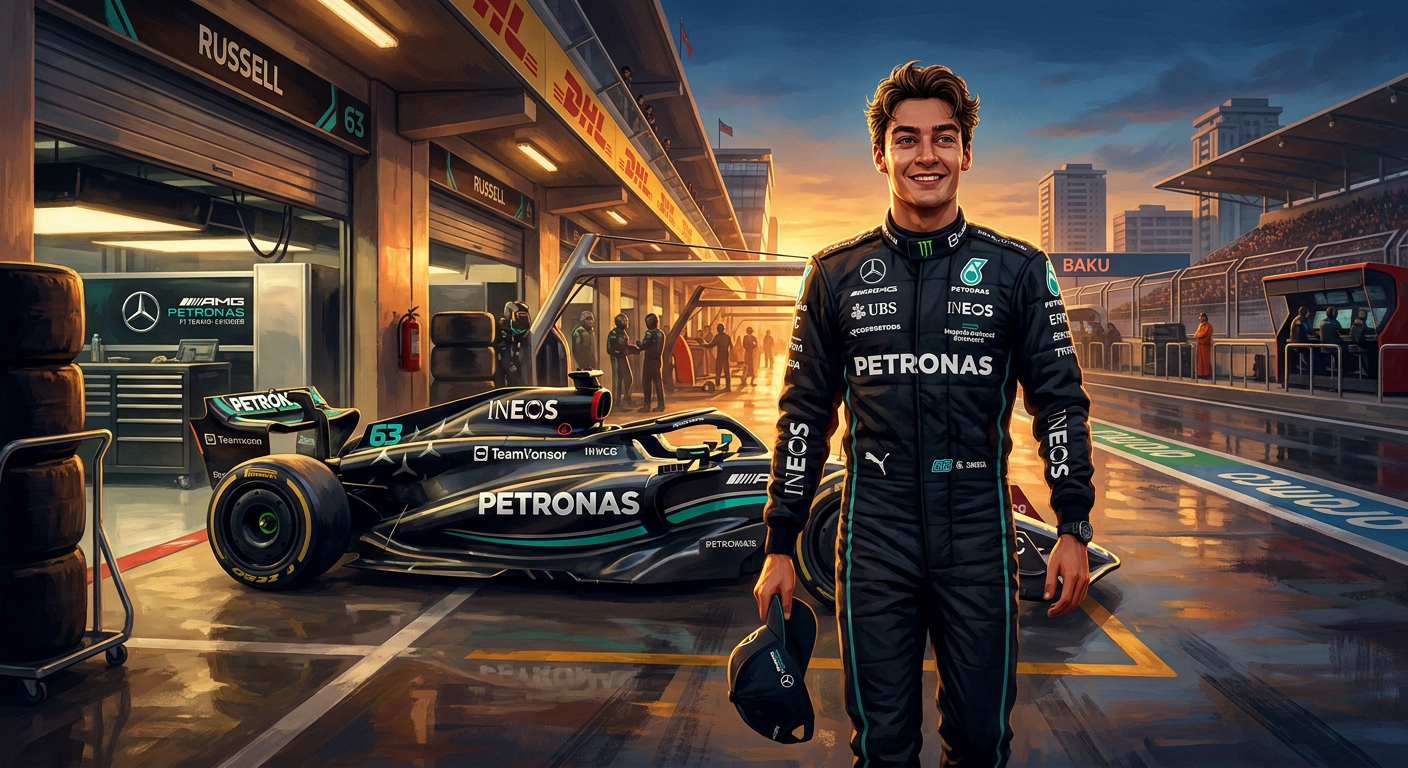

George Russell’s Azerbaijan Grand Prix victory on September 26 reduced Kimi Antonelli’s Formula 1 championship lead to 66 points and left Mercedes with a strategic decision it can no longer avoid. Antonelli has 302 points, Russell has 236 and Lewis Hamilton is third on 199. Mercedes also leads Ferrari by 160 points, meaning the team needs different approaches to protect the constructors’ championship and manage the drivers’ contest.
The distinction matters. Mercedes can race aggressively against Ferrari, McLaren and Red Bull, but it must take greater care over how Russell and Antonelli fight each other.
Russell keeps the title fight alive
Russell took 25 points in Baku after keeping Max Verstappen behind by 0.196 seconds. Antonelli finished fifth during what was described as his worst weekend of the season to that point. His advantage is still substantial.
Mercedes has won 11 of the opening 15 Grands Prix. Antonelli has eight of those victories, while Russell has three. That difference underpins the championship gap, but Baku increased the immediate pressure. Russell has proved that a difficult run does not have to leave him in a permanent supporting role.
“It would have been very easy for me to lose the faith”.
The championship arithmetic continues to favor Antonelli. The tactical situation is more complicated. Russell’s victory means Mercedes cannot reasonably ask him to give up track position while he sits second in the standings and remains capable of winning races.
Their next direct battle will be crucial.
Mercedes has room to avoid team orders
Mercedes leads the constructors’ standings with 538 points. Ferrari has 378, McLaren 306 and Red Bull Racing 263. Its advantage over Ferrari is 160 points, with McLaren 232 behind.
Those margins mean Mercedes does not need rigid team orders yet. Russell and Antonelli can run different tire strategies, target separate pit windows and race for position, as long as both cars are protected from avoidable contact.
The line should be clear. A team order intended to prevent a collision makes sense. Automatically moving Russell aside would be premature while the Mercedes drivers hold the top two positions in the championship.
Mercedes also has enough breathing room in the constructors’ standings to split its strategy instead of using both cars to cover the same rival. If one driver attempts the undercut, the other can extend in pursuit of an overcut or a later tire advantage. Ferrari, McLaren and Red Bull do not have that flexibility to the same degree.
Antonelli’s advantage changes his risk calculation
Antonelli’s eight victories came in China, Japan, Miami, Canada, Monaco, Belgium, Italy and Spain. Raw speed is no longer his strongest championship asset. He can now afford to reject unnecessary risk.
He finished second to Russell in Australia by 2.974 seconds and took third in Austria, 1.986 seconds behind the winner. In Hungary, Antonelli accepted third place, 18.728 seconds behind Lando Norris. Those results now carry strategic value. A podium or a solid points finish can be better than an ambitious pit call that leaves him in traffic or creates a late-race tire deficit.
The pattern favors a conservative default for Antonelli. Mercedes should cover Russell’s stop only when track position faces a genuine threat. Otherwise, the championship leader gains from clean air and fewer reactive decisions.
Russell has the opposite incentive. A 66-point deficit requires wins, and those often demand the first move into an undercut window or a stint extended beyond the comfortable crossover. He needs variance. Antonelli needs predictability.
Hamilton is the outside threat Mercedes must track
Hamilton is 103 points behind Antonelli and 37 behind Russell. Ferrari trails Mercedes by 160 in the constructors’ standings, but Hamilton’s position keeps him involved in the drivers’ contest.
Ferrari’s two victories this season came through Hamilton at Barcelona-Catalunya and Charles Leclerc in Britain. Hamilton beat Russell by 19.561 seconds on June 14, while Leclerc defeated Russell by 0.427 seconds on July 5. Those results show that Ferrari can punish Mercedes when the race shape or circuit characteristics fall its way.
“McLaren and Red Bull did a step forward that we didn’t do”.
Leclerc’s assessment after Baku captures Ferrari’s immediate issue. The team cannot base its title strategy on matching Mercedes. It needs aggressive pit timing and track position whenever an undercut opens up, because conservative calls maintain a gap that already favors its rival.
Hamilton’s tactical task is equally clear. He first needs to finish ahead of Russell. Catching Antonelli demands a bigger swing, but the 37-point gap to second allows Ferrari to complicate Mercedes’ internal management.
Red Bull and McLaren need disruption
Verstappen scored 18 points for second place in Azerbaijan, but Red Bull is fourth in the constructors’ standings on 263. McLaren holds third with 306 after Norris won in Hungary and the Netherlands.
Neither team can depend on matching Mercedes in conventional races. Their strongest option is to apply strategic pressure with an early stop, a long opening stint or a tire offset that forces Mercedes to split its response. Baku demonstrated how tight the margin can be, with Verstappen finishing only 0.196 seconds behind Russell.
Mercedes cannot answer every threat with one car. If Verstappen undercuts Russell while a McLaren extends against Antonelli, the championship leader and his teammate may require different responses. A dominant points advantage can then become operationally difficult instead of comfortable.
Bahrain will test Mercedes’ freedom
Round 16 runs from October 2 through October 4. Mercedes arrives in control of both championships, although its drivers require opposite strategies. Russell must pursue victories. Antonelli can protect his lead through consistent scoring.
Mercedes should hold off on championship team orders and retain strategic independence for both cars, with one firm limit: neither driver can damage the other’s race through an avoidable fight around a pit window.
That policy gets its next test when the Bahrain Grand Prix weekend begins on October 2.