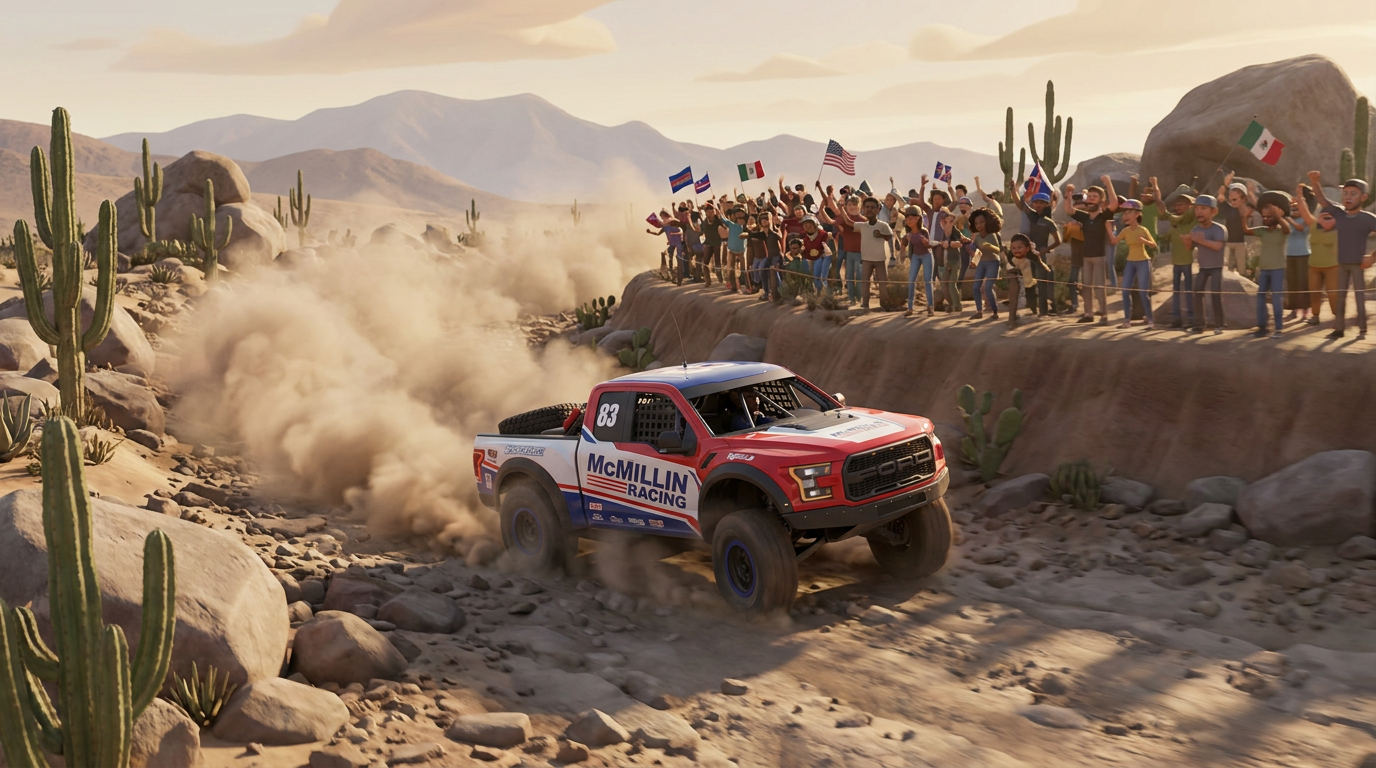
Luke McMillin swept the first three races of the 2026 SCORE season, but the Baja 400 showed why fans need clearer live timing, penalties and championship context.
Luke McMillin won the 7th SCORE Baja 400 on September 13, and his outstanding drive exposed what we see as the biggest weakness in SCORE International’s current product. The racing is ready for a global audience. The live sporting information isn’t.
McMillin and navigator Jason Duncan covered the 423.42-mile course in 8 hours, 40 minutes, 50 seconds in the No. 83 McMillin Racing AWD Ford Raptor Mason. The result made McMillin three for three in the 2026 SCORE World Desert Championship, following victories at the SCORE San Felipe 250 in March and SCORE Baja 500 in June.
This is no call to alter Baja’s competitive soul. Fans need the information required to understand the race as it unfolds.
McMillin has earned top billing
McMillin’s performance warrants an emphatic verdict: He’s the benchmark in SCORE Trophy Truck.
The Baja 400 win was his ninth in the division, putting him level with Ivan Stewart, Dan Smith, Dave Ashley and Mark Post. McMillin also joined Robby Gordon, Curt LeDuc, Bryce Menzies and Alan Ampudia on SCORE’s list of drivers with three consecutive Trophy Truck victories.
He completed the Baja Grand Slam by adding the Baja 400 to earlier wins in the San Felipe 250, Baja 500 and Baja 1000. That achievement gives SCORE a clear and compelling centerpiece for its championship coverage.
“I’m very excited that we’re three for three this season. It was an emotional day with a lot of ups and downs. With the dust, the sun, and everything else we faced, we were able to pull off the win. So I’m very, very happy and proud of the entire team,” McMillin said.
The coverage should convey the scale of McMillin’s performance in real time instead of leaving viewers to piece together its significance afterward.
Menzies made the winning margin matter
Bryce Menzies took second in 8 hours, 43 minutes, 22 seconds. The No. 7 Menzies Motorsports Ford Raptor Mason finished only 2 minutes, 32 seconds behind McMillin after over 8 hours of competition.
That’s an excellent result. It was Menzies’ third consecutive podium this season after third-place finishes at San Felipe and the Baja 500. Such consistency belongs at the center of the live championship story.
Desert racing makes that difficult. Entrants leave separately, elapsed time determines positions, and penalties can change the running order. Those complications demand authoritative communication. A permanent corrected-time leaderboard, along with immediate penalty notices and clear provisional labels, would help viewers understand the fight without changing Baja’s format.
SCORE planned Starlink connections alongside in-vehicle, drone and ground cameras for the Baja 400 stream. It also promoted live leaderboard tracking, a production team and a studio. That’s meaningful investment. Our verdict is simple: The next investment must put race control information on screen.
The classes deserve equal clarity
The issue reaches beyond the overall contest.
Carlos Apdaly Lopez won Trophy Truck Spec in 9 hours, 20 minutes, 22 seconds, defeating Mike Marsal by 51 seconds in a 29-team class. Justin Davis finished third. Lopez, the Mexican racer who claimed three Trophy Truck championships from 2015 through 2017, produced one of the weekend’s closest major-class wins.
Fans should’ve been able to track that corrected-time battle as easily as the Trophy Truck lead.
Maverick Gaunt and Chasen Gaunt earned their first Trophy Truck 2WD victory as well. Their No. 42T Geiser Bros Chevy Silverado completed the race in 9 hours, 52 minutes, 19 seconds. Mike Perez and Jonathan Faulkner placed second in 11 hours, 30 minutes, 16 seconds.
These details shouldn’t be buried. They are separate competitions featuring different machinery and their own stories. The broadcast needs rotating class leaderboards, fixed class identifiers and brief eligibility explanations. Fans shouldn’t have to check several documents to work out who’s racing whom.
Baja’s scale strengthens the case
Ensenada hosted 164 starting teams, with 102 officially reaching the finish. That 62-percent finishing rate conveys the punishment better than any promotional slogan.
Competitors also came from 23 U. S. states, Puerto Rico and countries including Mexico, Argentina, Australia, Canada and Japan. Given that reach, presenting detailed timing mainly for committed insiders shortchanges the championship.
We want three specific changes: corrected-time graphics synchronized throughout the stream, timestamped public notices covering penalties or time credits, and championship implications shown with every major class result. These are basic tools for explaining a complex race. They aren’t attempts to sanitize it.
The Baja 1000 is the deadline
McMillin’s next championship start gives SCORE a ready-made test. He’ll approach the season finale with three consecutive victories, while Menzies will arrive with three straight podiums.
Before the Baja 1000 begins, SCORE should publish one fan-facing guide explaining live timing, provisional classifications and penalty communication. It should then apply those same definitions to its broadcast graphics. McMillin has made the sporting story unmistakable. The finale must make it easy to follow from the first checkpoint.