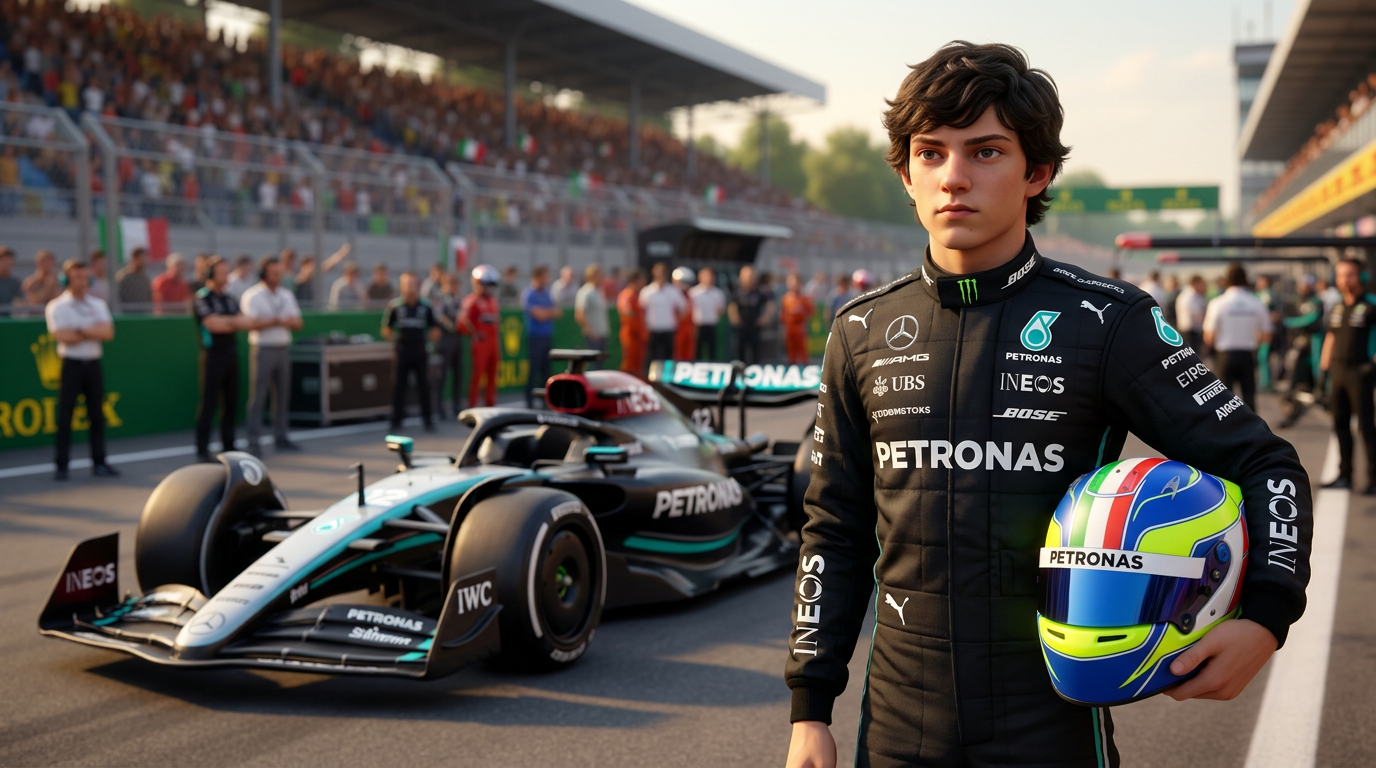

Kimi Antonelli has eight wins from 14 races, but the changing margins, rivals and circuits reveal how he and Mercedes are controlling 2026.
Kimi Antonelli won the Spanish Grand Prix on September 13, finishing 4.3 seconds ahead of Max Verstappen and taking his 2026 record to eight victories in the first 14 Grands Prix.
The total alone commands attention. How Antonelli secured those wins warrants a closer look. His margins have ranged from 1.9 seconds to 13.7, he weathered a weekend when Lando Norris held the stronger hand, and he capitalized at circuits as different as Monaco and Belgium.
Antonelli’s season has been shaped by adaptability, rather than a single, repeated form of superiority.
Eight wins, five different challengers
Antonelli started his winning run in China on March 15, beating Mercedes teammate George Russell by 5.5 seconds. Two weeks later in Japan, he crossed the line 13.7 seconds ahead of Oscar Piastri.
His margin over Norris in Miami was 3.2 seconds. Lewis Hamilton finished 10.7 seconds behind in Canada and 6.2 seconds back at Monaco. At Spa, Charles Leclerc trailed by 1.9 seconds, while Russell followed Antonelli home at Monza with a gap of 3.8 seconds.
Verstappen was the latest runner-up in Madrid.
Antonelli has now beaten five different second-place finishers across those eight wins: Russell, Piastri, Norris, Hamilton and Leclerc before Verstappen was added to the list. He hasn’t spent the season defeating the same title rival. Instead, he has dealt with whichever car and driver presented the most immediate threat.
Mercedes has distributed its strength
Mercedes has won 10 of the first 14 Grands Prix. Eight belong to Antonelli, with Russell claiming the other two in Australia on March 8 and Austria on June 28.
That difference is important in any historical assessment of the season. Team and driver dominance overlap, but they aren’t the same. Mercedes has won 71.4 percent of the races so far. Antonelli’s individual win rate stands at 57.1 percent.
The car has provided the competitive base, while Antonelli has converted most of the available Sundays. Russell’s victories show that either Mercedes driver can win. Antonelli’s eight demonstrate who has produced the greater return.
Ferrari broke Mercedes’ run through Hamilton at Barcelona-Catalunya on June 14 and Leclerc at the British Grand Prix on July 5. McLaren followed with consecutive victories for Norris in Hungary on July 26 and the Netherlands on August 23.
Antonelli answered with wins at Monza and Madrid.
The margins defy a simple verdict
Antonelli’s largest verified winning margin this season came in Japan on March 29, when he finished 13.7 seconds ahead of Piastri.
Those numbers matter because large winning margins are often used as shorthand for greatness. This season presents a finer distinction. Antonelli has delivered comfortable wins, then finished other races with a challenger close behind. Madrid fell between those two ends of the scale, with Verstappen 4.3 seconds back and Norris trailing by 5 seconds after 57 laps.
His advantage, then, hasn’t relied on overwhelming the field each Sunday. The results show repeatable execution as the competitive order changes.
The wins also span markedly different race distances, from Belgium’s 44 laps to Monaco’s 78. The Belgian Grand Prix lasted an hour and 24 minutes, while Monaco took two hours and 23 minutes. Antonelli won both.
A different test from counting records
Formula 1’s all-time comparisons often start with championships and career victories. Antonelli’s season is still too young for that calculation. Eight wins don’t put him alongside the championship records of Lewis Hamilton or Michael Schumacher, while 14 rounds can’t define a career.
They do allow a tighter comparison of competitive form.
Antonelli won at Shanghai, Suzuka and Miami before adding victories in Canada and Monaco. Spa, Monza and Madrid completed the set. That geographic reach provides concrete evidence of his range, although calendar variety can’t account for differences in machinery, regulations or opposition across eras.
The strongest case for Antonelli’s 2026 campaign goes beyond the total. There is no single, narrow formula behind his victories. Different runners-up, margins and race durations have all ended with the same winner.
Baku provides the next measurement
Round 15 is the Azerbaijan Grand Prix, scheduled for September 24 to 26. Antonelli heads to Baku after consecutive wins at Monza and Madrid, with Mercedes on 10 victories from 14 races.
A ninth win for Antonelli would lengthen the season’s defining run. A response from Russell, Ferrari or McLaren would clarify the difference between Mercedes’ advantage and Antonelli’s conversion rate.