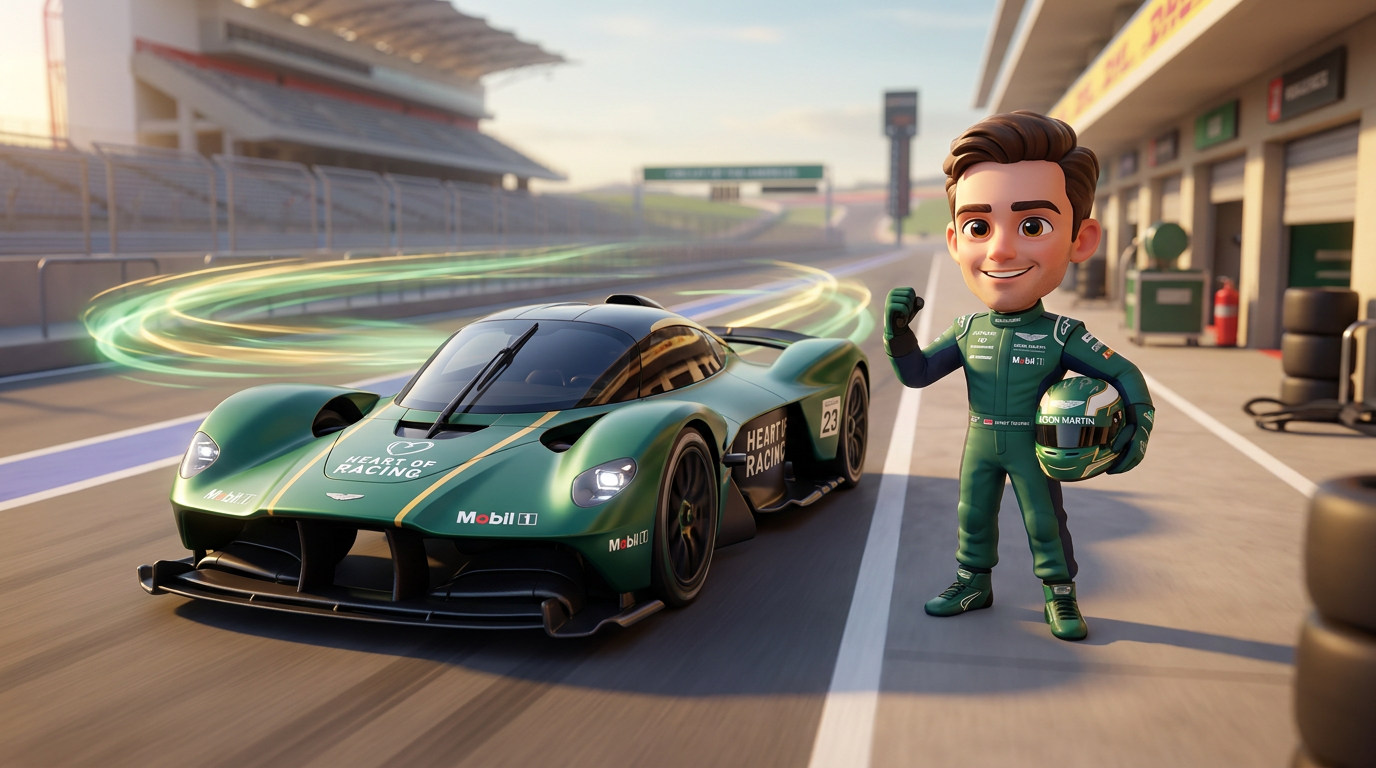
Aston Martin led both WEC classes in Austin practice, linking its current Hypercar program to a championship-winning endurance legacy.
Aston Martin topped both FIA World Endurance Championship classes in second practice at COTA. Harry Tincknell led Hypercar, while Zacharie Robichon set the LMGT3 pace. One session doesn’t rewrite history, but it reconnects the current program with one of endurance racing’s oldest elite names.
A rare double at COTA
Tincknell’s benchmark put the Aston Martin Valkyrie ahead of its Hypercar rivals before the 2026 Lone Star Le Mans. Robichon completed the manufacturer sweep in LMGT3, making Aston Martin fastest in two categories during the same session.
The result carried weight after Ferrari controlled first practice with a 1-2, led by Antonio Giovinazzi ahead of Antonio Fuoco.
The 1959 standard
Aston Martin reached its historic peak in 1959. Roy Salvadori and Carroll Shelby won the 24 Hours of Le Mans in the DBR1, with Maurice Trintignant and Paul Frère finishing second.
That Le Mans result anchored Aston Martin’s World Sportscar Championship title the same year. It remains the clearest reason to place the marque among endurance racing’s great manufacturers, although its top-level success has been less sustained than Porsche, Ferrari and Toyota.
Why the eras resist simple comparison
The 1959 DBR1 raced in a championship centered on sports cars and long-distance classics. The 2026 Valkyrie competes under Hypercar regulations in the modern WEC, which began in 2012 and uses Balance of Performance to manage fundamentally different technical concepts.
Raw victory totals are therefore an imperfect ranking tool.
Aston Martin’s strongest case is its range. The record runs from an overall Le Mans victory and world title in 1959 through modern WEC class championships and victories, then to a return to the premier division with the Valkyrie.
Drivers define the generations
Salvadori and Shelby remain Aston Martin’s defining overall-winning crew. Tincknell now carries part of the marque’s Hypercar responsibility, while Robichon’s FP2 performance shows the continuing strength of its GT operation.
The contrast is clear. Two drivers shared the Le Mans-winning DBR1 in 1959. Modern WEC entries generally split long races among three drivers, increasing the importance of lineup depth and traffic management across multiple classes.
The next historical measure
Aston Martin leaves Friday with speed, but no result yet. The Lone Star Le Mans at COTA is the next test, followed by Fuji on September 27, Barcelona on October 18 and Monza on November 8.
Qualifying will determine whether Tincknell can turn the Valkyrie’s FP2 pace into a starting position that takes Aston Martin closer to its first modern WEC Hypercar victory.