
Baja replaces fixed laps and pit walls with navigation, mobile chase crews, blinding silt and hours of racing after dark.
A Baja run isn't a grand prix extended across the desert. Circuit racing keeps the competition within a controlled venue. Baja sends crews along a long, changing route, where locating the course and reaching assistance are part of the sporting challenge.
That distinction changes everything. Speed still counts, but the usual reference points from Formula 1, MotoGP and IndyCar don't fully explain what these competitors are doing.
The course isn't learned one corner at a time
A grand prix driver uses practice to build a detailed picture of a fixed lap. Braking markers don't move. Curbs stay visible. The next corner appears exactly where expected on every lap.
Baja offers no comparable cycle of repetition. Competitors follow a prescribed route through open terrain, relying on the event's navigation information and course markings while assessing hazards at racing speed. Missing a turn costs distance and time, even when the vehicle remains mechanically healthy.
The navigator or co-driver is central to performance, rather than a passenger who reads occasional directions. The FIA recognizes cross-country as a separate branch alongside circuit competition, with the World Rally-Raid Championship and multiple Baja cups sitting outside Formula 1 and WEC.
The chase crew replaces the pit wall
Formula 1 teams work from a single pit lane. During the 2026 Australian Grand Prix, George Russell completed 58 laps in 1:23:06.801, passing the same garage and pit wall each time around.
A Baja support operation stays mobile.
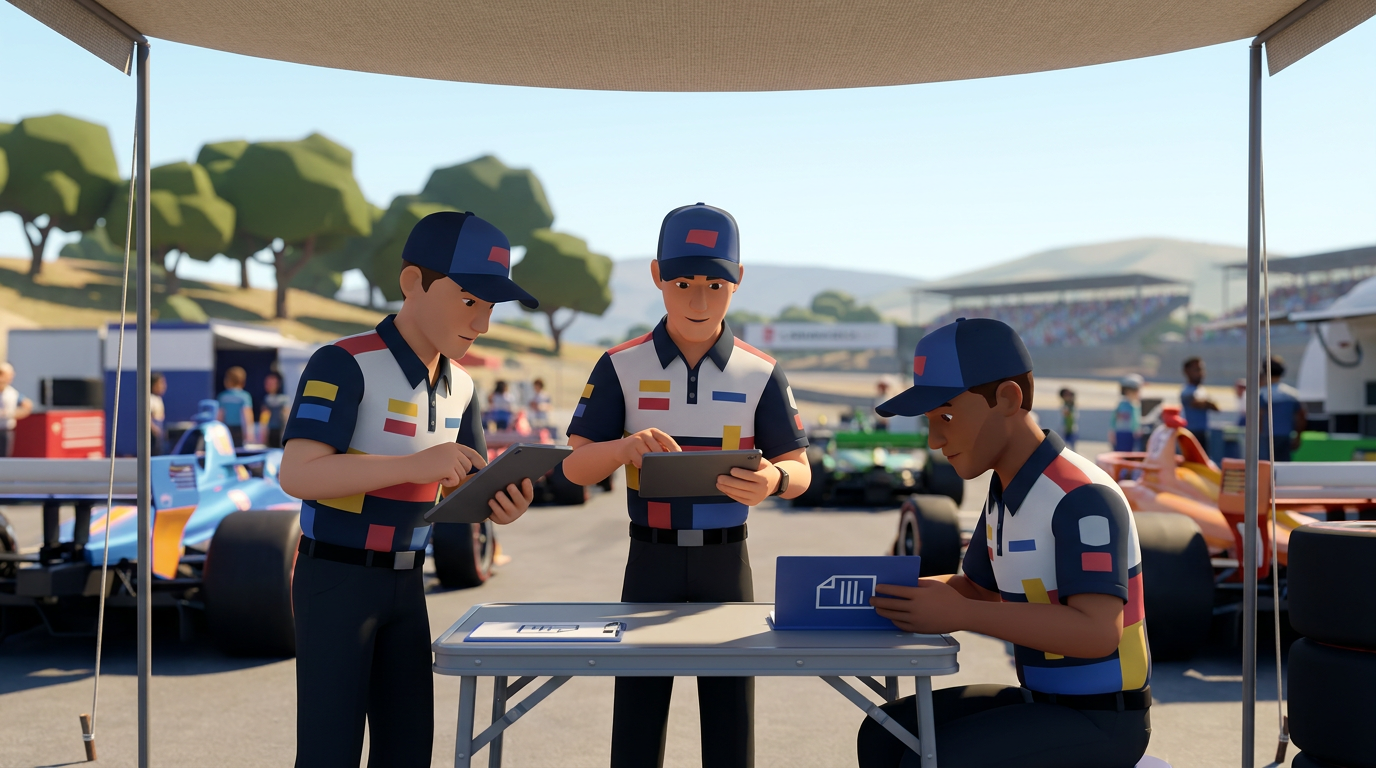
Chase crews carry tools, parts and supplies between permitted access points, aiming to reach the next service location before the race vehicle. Public-road travel, distance and timing dictate their day. If a competitor stops in an inaccessible location, a fully stocked truck miles away can't provide an immediate fix.
This is where circuit fans often undervalue the team. The personnel outside the race vehicle must predict failures and place resources across a vast area. Communication may be limited. Recovery can take hours instead of the duration of one pit stop.
Silt isn't ordinary dust
Dust limits visibility. Silt can eliminate it.
Fine desert material lingers in the air, hiding ruts, rocks or a stopped competitor. It also creates deep beds that drain momentum. Enter too slowly and the vehicle may bog down. Attack too aggressively, and an unseen hole can cause suspension damage.
Following another vehicle requires a different calculation than running in dirty air on a circuit. In the 2026 British Grand Prix, the top three finished within 0.772 seconds after 52 laps. Baja competitors may intentionally leave space because driving into an opaque silt cloud strips away the visual information required to continue safely.
Traffic also changes the surface. Early starters may tackle an uncleared route, while later runners encounter churned tracks and suspended dust. Neither starting position guarantees easier conditions.
Night running rewrites the route
Formula 1 stages night races, including Singapore and Las Vegas on its 2026 calendar, but those venues feature illuminated circuits, barriers, marshal posts and familiar corner sequences.
Darkness in Baja presents another challenge. Vehicle lights create a narrow tunnel as the surrounding terrain vanishes. Dust throws glare back toward the crew. Similar-looking tracks branch in several directions, while depth becomes more difficult to judge. Hours of vibration and sustained concentration add fatigue to every problem.
The route hasn't physically changed, but it reads like a different course.
That shift rewards restraint. A competitor attacking visible terrain in daylight may have to protect the vehicle and follow navigation with greater discipline after sunset. Raw pace counts for little if a wrong branch adds miles or a hidden impact ends the run.
The stopwatch tells only part of the story
Circuit audiences learn to interpret gaps immediately. IndyCar's 2026 standings, for example, show Alex Palou on 607 points after 17 starts, with Christian Lundgaard 100 behind. Position stays visible and receives continuous updates.
Baja's running order can be more difficult to understand from the roadside. Vehicles may start at intervals, meaning the first one in view isn't necessarily the elapsed-time leader. Stops, navigation mistakes and penalties can reorder the classification without a conventional on-track pass.
This isn't circuit racing minus the asphalt. It's a distinct discipline shaped by distance, uncertainty and self-sufficiency, which is why the FIM lists Cross-Country among seven motorcycle disciplines covering over 100 categories.
How to watch Baja differently
Stop looking for the perfect lap. Track where a crew gains or loses time, check whether it reaches service, and observe how its approach shifts in silt or darkness. A slower section may reflect damage control rather than poor pace.
The next decisive event may unfold far from the visible race vehicle, with a chase truck traveling toward its permitted service point carrying the exact part needed to keep the run alive.