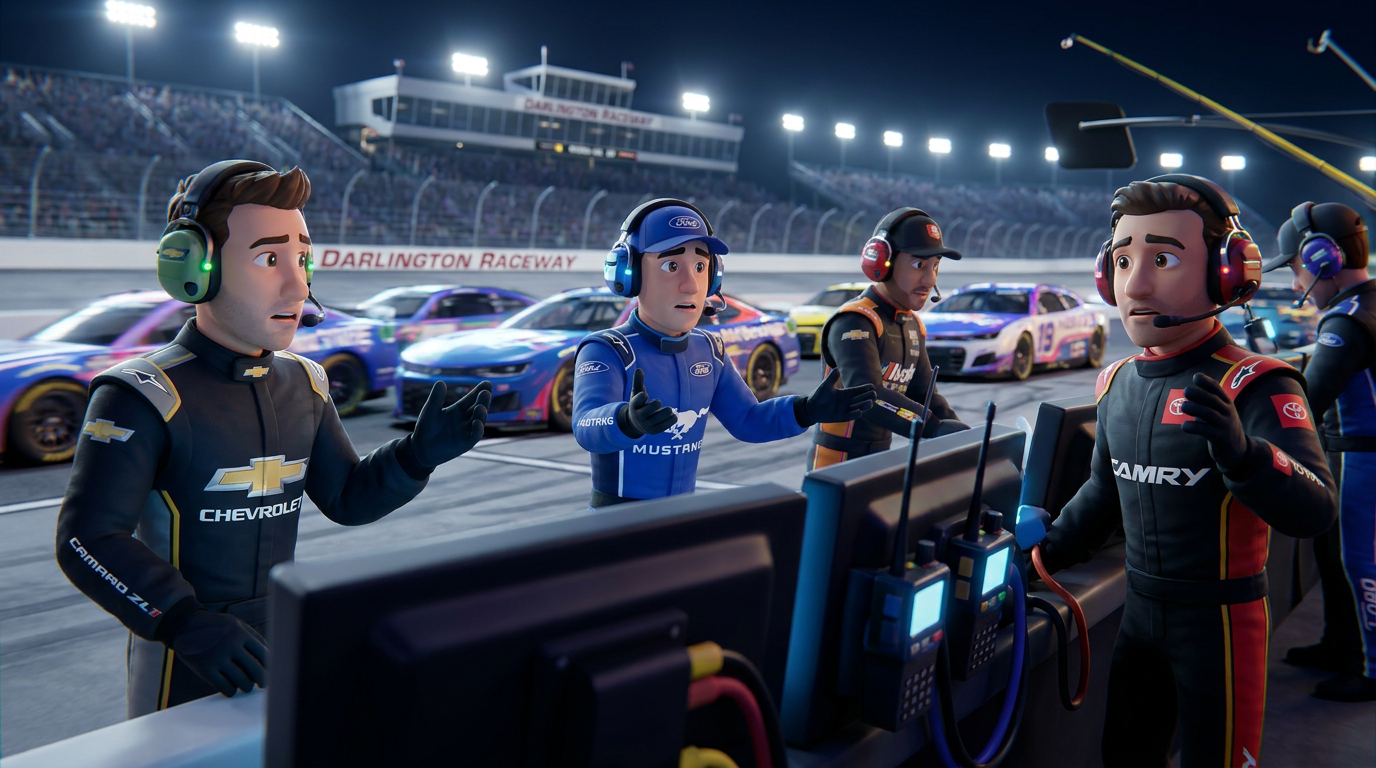

Christopher Bell won the Southern 500, but NASCAR’s playoff system muted his reward while preserving the advantages held by powerhouse teams.
Christopher Bell passed Kyle Larson with 12 laps remaining in Sunday’s 77th Southern 500, snapping a 33-race winless streak and delivering a compelling start to NASCAR’s Chase. The updated standings produced a less convincing result. Bell’s victory barely shifted a playoff order structured to preserve the advantages amassed by the strongest teams.
Our position is straightforward: NASCAR’s playoff bonuses, resets and three-race elimination rounds give leading organizations too much protection. Regular-season performance deserves weight, but the current formula turns that reward into insulation from the postseason consequences facing everyone else.
Bell deserved a bigger reward
Bell arrived at Darlington without a 2026 victory, even after seven runner-up finishes that tied a series record. He finally converted his persistent speed into a win by tracking down Larson late and pulling away.
That blend of season-long consistency and Southern 500 execution should carry enormous championship value.
Instead, Bell left Darlington second in the updated playoff standings with 2,123 points, still trailing Joe Gibbs Racing teammate Denny Hamlin on 2,135. Hamlin secured the No. 1 seed and the benefits tied to his regular season. His work merits that recognition. We dispute the size and staying power of the cushion.
The strongest teams control the safety net
Bell’s win also demonstrated Joe Gibbs Racing’s ability to find speed and execute on an abrasive track. Larson and Hendrick Motorsports stayed in contention until the final 12 laps. Tyler Reddick held fourth in the updated standings with 2,111 points, while Ryan Blaney ranked third on 2,119.
They’re excellent drivers with leading programs. They should contend.
Yet the format gives those organizations several chances to build protection through wins, stages and playoff bonuses before the reset. Their simulation capabilities and strategic depth help them collect stage points, then those rewards carry into short elimination rounds.
Larson stood seventh on 2,086 after losing the race. Chase Elliott and Joey Logano were tied at 2,063, while Bubba Wallace held 10th with 2,054. After one Chase event, familiar names remained clustered near the front because the system keeps earlier bonuses in play.
One bad result punishes smaller teams more
The bottom of the order shows the imbalance. Chris Buescher had 2,047 points, Carson Hocevar 2,046 and Daniel Suárez 2,041. Austin Cindric followed on 2,033, Ryan Preece had 2,031 and William Byron stood at 2,021.
Every contender deals with mechanical failures and crashes. A poor finish, however, hits a driver near the cut line much harder than a top seed carrying a sizable reserve of bonus points. Three-race rounds magnify that gap, particularly for teams without the resources to gather stage points regularly.
NASCAR has confused volatility with parity. A lower-seeded driver’s automatic route forward through a victory doesn’t balance a system that rewards the same organizational advantages at every stage.
NASCAR should reduce the bonuses
We would keep a playoff while reducing the playoff points awarded for race and stage wins. A season’s second, third or later victory shouldn’t continue expanding a contender’s postseason shield at the same rate. A cap would maintain the incentive to win without letting one dominant run skew every reset.
Stage points should carry less influence, too. Stages can stay within the race structure, but the championship should give greater weight to the finishing order after the full distance.
The opening rounds need another safeguard. Allow each driver to discard one worst result per round, or postpone elimination until competitors have completed a longer sample than three races. Either option would reduce the championship damage from one failure without erasing the value of sustained excellence.
Darlington delivered the right kind of drama
Bell didn’t need an artificial points cliff to give Sunday significance. He chased Larson, made the decisive pass with 12 laps remaining and ended 33 races of frustration at one of NASCAR’s defining events.
The rules should elevate that achievement while preserving the importance of the full season. NASCAR’s next step should be a formal review of playoff bonuses and stage-point values before the 2027 competition regulations are locked.