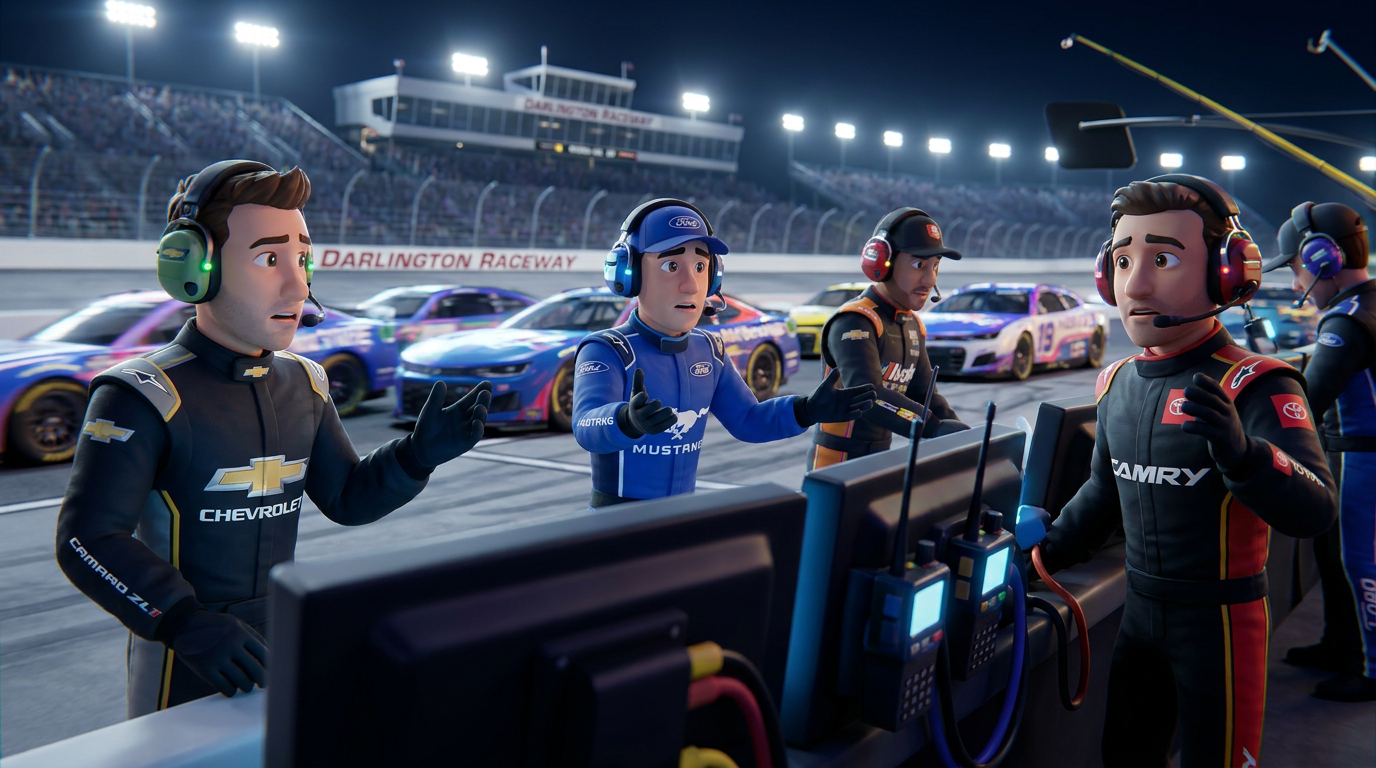
A $1,115 bill for 223 Southern 500 radio violations exposes a policy that sanitizes NASCAR without making its racing safer or fairer.
NASCAR paid $1,115 after drivers swore 223 times over the radio during Sunday’s 2026 Southern 500 at Darlington. Our verdict is straightforward: this enforcement is pointless. Policing private team communications for profanity strips personality from the broadcast and does nothing to improve competition.
The numbers expose the problem
The 223 violations cost $5 apiece. That amount is too small to change behavior, but the policy still treats ordinary frustration as an offense that must be tracked throughout an entire race.
Christopher Bell won the Southern 500 after passing Kyle Larson late. Yet the strangest postrace statistic involved language, not racing.
Darlington is demanding. Tempers will flare.
Radio should sound authentic
Fans listen to team radio because it offers access they can’t get from the grandstands. Drivers are under pressure, communicating at speed and responding instantly to contact or mechanical trouble. Those exchanges lose their value if competitors have to talk as if every transmission were a prepared interview.
We’re not calling for unrestricted abuse. Threats, discriminatory language and targeted harassment deserve intervention. A routine expletive after a mistake doesn’t belong in the same disciplinary category.
The difference is conduct versus vocabulary.
A small fine solves nothing
A $5 charge won’t keep a Cup driver from swearing during the Southern 500. The $1,115 total confirms it. NASCAR covered the cost, the words were still said, and no competitive result changed.
If broadcasters need clean programming, delayed audio and selective playback are practical solutions. The live sporting product shouldn’t be altered because an unfiltered radio transmission might reach the air.
The current policy produces paperwork, not accountability.
Real conduct deserves attention
Sunday’s race at Darlington featured incidents with real sporting consequences. William Byron retired because of an engine failure. Denny Hamlin’s run-in with Michael McDowell derailed his day. Chase Elliott and Ryan Blaney helped stalled 23XI Racing cars, while Bubba Wallace finished eighth.
Those details mattered because they affected people, points and machinery. Radio profanity didn’t.
NASCAR should save penalties for actions that compromise safety or fairness, or interfere with another participant’s ability to compete. It should also set a firm boundary against personal abuse. Everything else can be handled through broadcast standards without making spontaneous speech a financial violation.
NASCAR should rewrite this rule
Our preferred policy is narrow. Penalize slurs, direct threats and sustained harassment. End fines for isolated profanity on team channels, then let broadcasters choose which clips are suitable for air.
That would protect competitors without sanitizing them. Fans would also get a more accurate sense of what happens inside a Cup race, particularly during a pressure-heavy event such as the Southern 500.
The next step belongs in the rulebook: define abusive conduct precisely, remove routine swearing from the fine schedule and leave ordinary frustration on the radio.