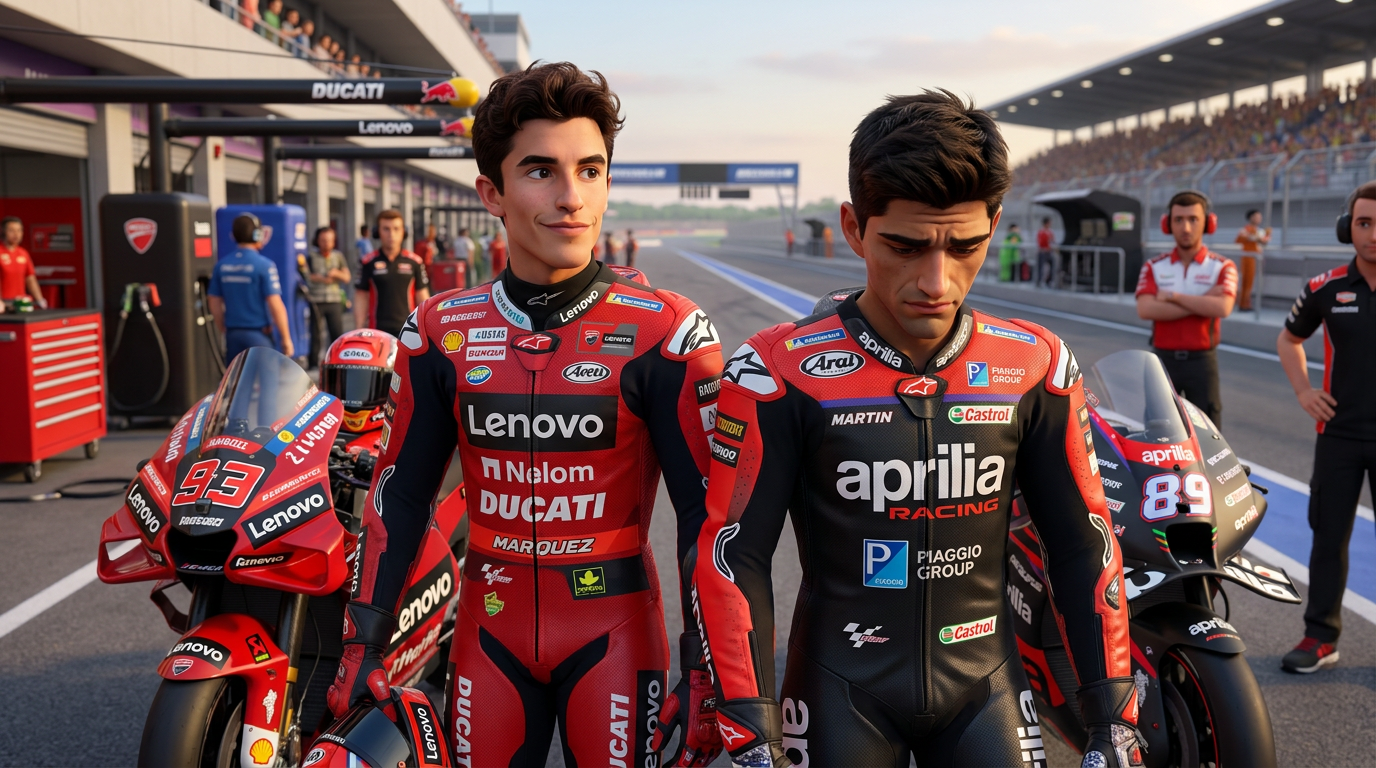
Marc Marquez and Jorge Martin leave Misano tied on 274 points, creating a rare comparison between winning frequency and season-long accumulation.
Marc Marquez left round 14 at Misano on September 13 at the top of the 2026 MotoGP standings with 274 points. Jorge Martin has exactly the same total.
The tie offers a revealing test of greatness. Marquez has won five Grands Prix and secured seven podiums this season. Martin has one victory and six podiums. They have reached the same score through sharply contrasting campaigns, turning the championship into a live debate over how dominance should be measured.
Five wins have produced no points cushion
Marquez’s San Marino Grand Prix victory moved him to first in the standings after Bezzecchi crashed on the opening lap. It completed a Misano sweep, following Marquez’s sprint win over Bezzecchi, and gave the Ducati Lenovo Team rider another victory in his formidable 2026 campaign.
Martin’s Aprilia campaign has taken a different path. His one win is four fewer than Marquez’s total, and his six podiums leave him one behind Marquez. Yet the defending points equation, counting every scoring finish and the sprint contribution, has put Martin level with the rider who has won most often between them.
Victories alone aren’t defining this title race. Marquez has turned his best weekends into the biggest prizes, while Martin’s wider accumulation has erased the apparent performance gap. Greatness across a season requires both dimensions, and the 274-point tie makes their relative value unusually clear.
Misano showed the cost of one mistake
Bezzecchi arrived at his home round as a central title contender and claimed a record-breaking pole position. He finished second to Marquez in the sprint, then crashed out of Sunday’s Grand Prix on the opening lap.
He said the retirement “hurts a lot” but rejected pressure as the cause.
Bezzecchi is now third on 241 points, 33 behind Marquez and Martin. His record remains impressive, with four victories and eight podiums, the highest podium total among the leading trio. Still, one scoreless Sunday changed his position.
That’s the harsh arithmetic of a close championship.
Bezzecchi’s eight podiums demonstrate his competitive range, but they cannot fully shield him from a major non-score. His four wins put him much closer to Marquez’s race-winning level than Martin’s. His deficit, however, explains why historical rankings can mislead if wins and podiums are considered without the context of costly failures.
The leaderboard rewards different strengths
The contrast continues beyond the top three. Fabio Di Giannantonio is fourth with 223 points, one win and three podiums. Pedro Acosta follows on 209 despite having no victories, backed by five podium finishes.
Ai Ogura holds sixth with 203 points, one win and four podiums. Raul Fernandez is seventh on 199 with the same victory and podium totals. Alex Marquez sits eighth on 153 after one win and two podiums.
Those figures provide a useful control group. Acosta has outscored two race winners without taking a victory himself. The pattern shows that consistency still carries enormous championship value, even during a season in which headline wins shape public perceptions of rider quality.
Alex Marquez’s assessment of his brother at Misano adds another dimension. He said Marc was “playing with us” during the fight, presenting the winner as a rider managing the race instead of revealing his full pace. That control has long carried weight in greatness debates because it distinguishes raw speed from strategic command.
Bagnaia offers the opposite comparison
Francesco Bagnaia’s position supplies the standings’ starkest historical reference. He is ninth with 143 points, no wins and four podiums, already 131 behind the championship leaders after round 14.
Bagnaia has one more podium than fourth-place Di Giannantonio, yet trails him by 80 points. He also has one fewer podium than Acosta and is 66 points behind the KTM rider.
The conclusion is straightforward. Podium totals become weak measures when separated from finishing distribution and non-scores. A rider’s championship record counts the bad weekends as firmly as the celebrated ones. That is why career title totals hold such authority in discussions about MotoGP’s greatest riders, although they never explain everything about speed or opposition.
A modern title can defy simple ranking
Marquez has seven premier-class championships, level with Valentino Rossi and one behind Giacomo Agostini’s eight. The current campaign gives him a route to matching that premier-class record, but the live standings also caution against treating his five 2026 wins as proof of control.
Martin is level without matching Marquez’s winning frequency. Bezzecchi is 33 points behind despite leading the trio with eight podiums. Three credible title profiles coexist after Misano: concentrated dominance, persistent accumulation, and broad front-running speed damaged by one major error.
Marquez called his rivals’ misfortune a “present” after the San Marino Grand Prix and said it tasted “sweet.” He must now convert that gift into a points advantage, while Martin will decide after the Austrian Grand Prix whether to undergo surgery for the arm pump that affected him at Misano.