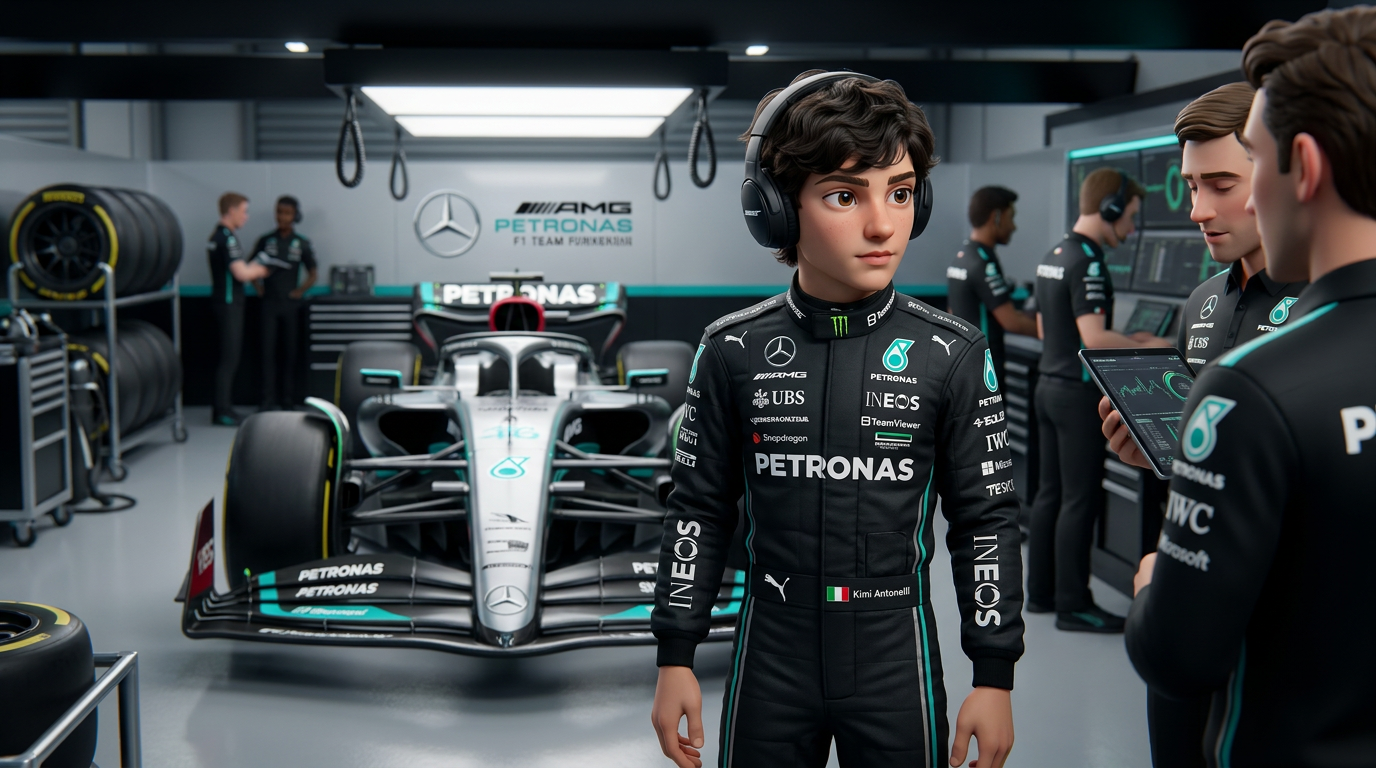
Mercedes is investigating why its Bahrain Grand Prix in Malaysia upgrade failed to produce the expected qualifying performance at Sepang.
The team introduced a new floor and sidepods, then recorded its toughest qualifying result of the 2026 Formula 1 season.
The available evidence does not isolate one technical failure. Instead, Mercedes faces questions over how the revised aerodynamic package interacted with setup, tires and Sepang’s demanding layout after Kimi Antonelli’s practice recovery did not carry into qualifying.
A substantial aerodynamic change
Autosport reported that Mercedes brought a new floor and sidepods to the Sepang weekend. Those components form a closely connected aerodynamic system: sidepod geometry influences the airflow reaching the floor edges, while the floor controls a large share of the car’s downforce.
Changing both areas gives the team scope to alter airflow around and beneath the car, but it also increases the setup work required. The Race reported after qualifying that the upgraded car had underwhelmed and that Mercedes was examining multiple contributing factors.
Neither Mercedes nor the cited reports established that the parts themselves were defective. Motorsport.com described the package as a “big question mark,” while team principal Toto Wolff said, “Something else is going on.” His comment left the cause open rather than assigning the setback to the upgrade alone.
Friday exposed the initial problem
The upgrade’s competitive picture changed sharply across the weekend. Mercedes described Friday as one of its toughest of the season, according to Formula 1’s official news listing. Motorsport.com reported that Antonelli finished no higher than fifth in either Friday session.
George Russell also said Mercedes was “a bit off the pace” and warned that rival teams posed significant threats. That assessment followed a day in which Charles Leclerc led second practice and Mercedes occupied seventh and eighth, according to Autosport’s report.
Those positions do not reveal whether the deficit came from aerodynamic load, balance or tire preparation. The supplied material contains no verified sector times, speed-trap readings, downforce levels or setup figures, so no specific weakness can be assigned to the car’s slow-, medium- or high-speed performance.
Antonelli’s FP3 rebound complicated the diagnosis
Antonelli then led final practice on Saturday. The FIA and Formula 1 both recorded him as the fastest driver in FP3, while Motorsport.com characterized the result as a recovery from a difficult Friday.
That turnaround showed the Mercedes could generate front-running pace in at least one session after its early difficulties. It did not, however, prove that the underlying problems had been solved. Practice and qualifying impose different demands because fuel loads, tire preparation, track evolution and run plans can vary.
The supplied sources do not provide Mercedes’ fuel levels or tire programs, preventing a direct comparison between its FP3 pace and qualifying performance. They also contain no verified brake-temperature, energy-management or tire-degradation data. Any claim that one of those factors caused the reversal would go beyond the evidence.
Tires remain part of the inquiry
Sepang’s tire demands were a prominent concern throughout the weekend. Sky Sports published comments from Russell and Antonelli under the description “Tyres are going through hell!” Formula 1 also reported that Leclerc had identified a main talking point when assessing performance, while Paddock Buzz previously covered his warning over tire wear.
For Mercedes, the unresolved issue is whether the revised package provided a sufficiently stable platform across the relevant operating conditions. Qualifying performance depends on bringing the tires into their working range while preserving balance through the lap. The supplied reports do not include tire temperatures, pressures or degradation figures, so the precise interaction remains unconfirmed.
No clear sector or straight-line answer
The research material contains no numerical sector comparison or speed-trap table for Mercedes, Ferrari and Red Bull. It therefore cannot support a conclusion that Mercedes lost its time mainly on Sepang’s straights or in a particular sequence of corners.
Max Verstappen delivered the first pole of 2026 by a car without Mercedes power, according to The Race, while Lewis Hamilton put Ferrari on the front row. Those outcomes establish that Red Bull and Ferrari extracted stronger qualifying performance, but they do not identify whether aerodynamic efficiency, mechanical setup, tire use or another factor created Mercedes’ deficit.
Brake and fuel management are similarly unresolved. No supplied source reported abnormal brake behavior, fuel-saving requirements or an energy-management limitation for Mercedes in qualifying.
Race becomes the next technical test
Mercedes entered round 16 leading the constructors’ standings with 538 points, ahead of Ferrari on 378 and McLaren on 306. Antonelli also led the drivers’ championship on 302 points, according to Motorsport.com.
The race will provide longer-run evidence on the new floor and sidepods, including whether Mercedes can manage its tires well enough to recover. Motorsport.com reported that Antonelli was considering an aggressive undercut, but the central engineering question remains unanswered: whether the Sepang qualifying setback reflected the upgrade, its setup window or the combination of several factors Wolff’s team is still investigating.