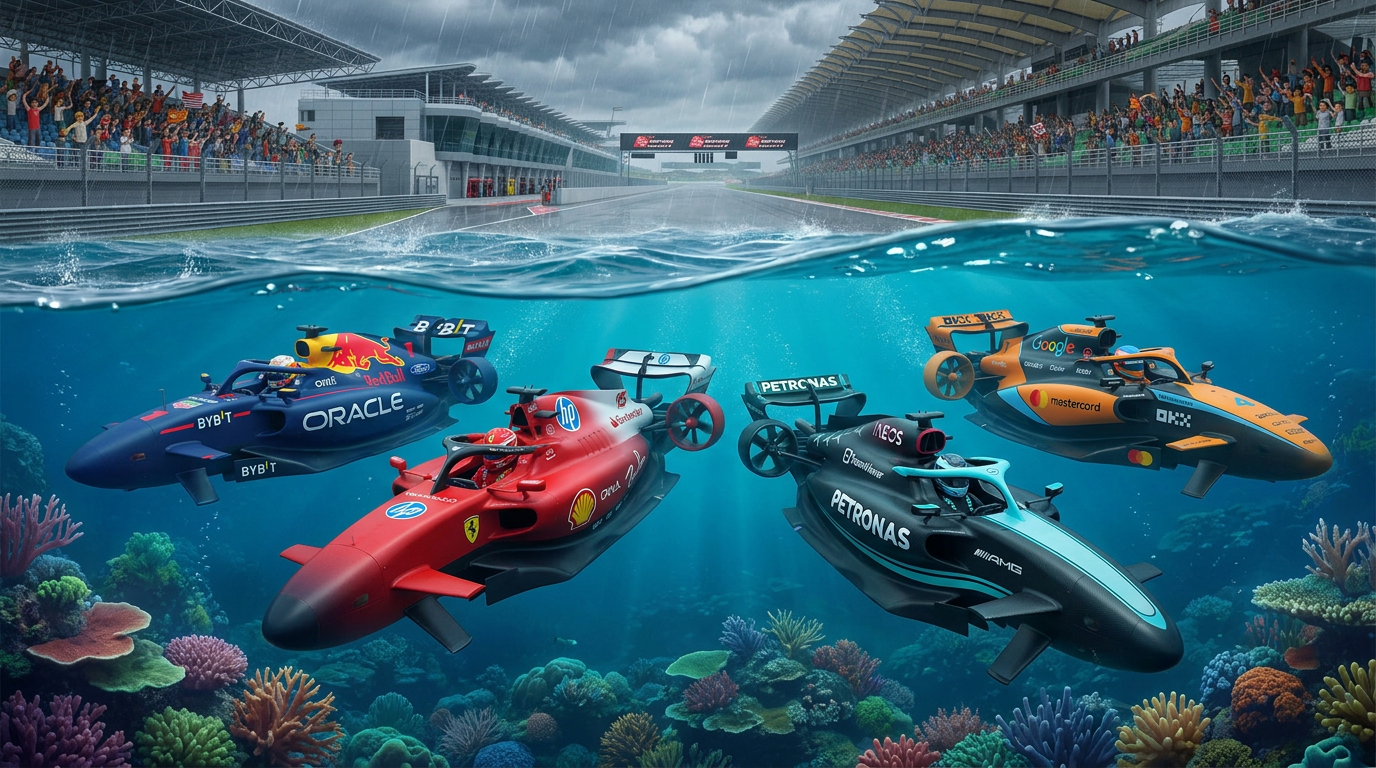
Formula 1’s return to Sepang exposed a technical problem more important than the eventual result: the 2026 cars struggled to function in conditions that should permit wet-weather racing.
The FIA, teams and Pirelli must treat that failure as an urgent engineering issue, not dismiss it as an unusually difficult afternoon.
Heavy rain delayed the Bahrain Grand Prix in Malaysia, and The Race reported that an attempted start on a damp track was abandoned after multiple cars stopped during the formation laps. A venue drivers and Pirelli had identified as a strong candidate for rain running instead became evidence that the new formula is not yet robust enough.
The problem went beyond tire grip
Wet-weather performance is often reduced to a debate about whether the full-wet tire has enough grip or sheds too much spray. Sepang revealed a broader system problem. Multiple cars stopping before the race could begin points beyond a simple lack of driver confidence at the limit.
The available reporting does not establish a single common technical cause for every stoppage, so it would be wrong to assign one. But the pattern matters. These cars combine new power-unit demands with tight thermal, electrical and brake-management requirements. When several cannot complete formation running on a damp circuit, Formula 1 has to examine how those systems interact at low speed, behind controlled starts and in heavy humidity.
Sepang was supposed to be the best case
Motorsport.com reported before the race that concerns already surrounded the 2026 cars in wet conditions, although several drivers and Pirelli considered Sepang the best place for a rain-affected grand prix. That judgment was logical. Sepang is a permanent circuit with substantial runoff, rather than a narrow street course where visibility and recovery access create further constraints.
That makes Sunday’s failure more troubling. If Formula 1 cannot confidently launch a wet race at this venue, the category cannot assume that the same package will cope at circuits offering less margin. The event finished more than three hours after its scheduled start, according to The Race. Delay alone is not proof of bad race control when rain is severe, but the aborted attempt showed that waiting was not the only issue.
Aero efficiency means little without operability
The weekend had already highlighted sharply different aerodynamic compromises. Motorsport.com reported a recurring straight-line-speed problem on Lando Norris’s McLaren, while the official Formula 1 site carried Norris’s admission that McLaren was “a long way off the pace.” Red Bull, by contrast, placed Max Verstappen on pole and converted the weekend into its first victory of 2026.
Those dry-performance differences matter to normal setup analysis: teams balance wing level, drag, tire energy and sector performance around Sepang’s long straights and fast corners. Yet wet operability sits beneath all of them. A car’s speed-trap figure or cornering load is irrelevant if its power unit, brakes, energy systems or tires cannot stay within a usable window during formation laps.
Fuel and brake management need scrutiny
Formation running creates an awkward operating state. Cars move slowly, cooling airflow falls and drivers must manage temperatures while preparing tires and brakes. Rain adds water, lower surface temperatures and reduced tire loading. The 2026 regulations have changed the technical equation, making any weakness in energy deployment, harvesting, brake-by-wire behavior or thermal control especially significant.
There is not enough public data to say which subsystem failed on each car. That uncertainty strengthens the case for a transparent technical review. The FIA and teams should publish a clear account of the failure categories once their analysis is complete, while protecting genuinely proprietary details. Fans do not need software maps, but they deserve to know whether the stoppages shared a regulatory or architectural cause.
Pirelli cannot solve this alone
Tire behavior remains part of the investigation. A wet tire must generate temperature at restricted speed, clear water and provide predictable degradation once conditions improve. But asking Pirelli to cure the entire problem through compounds or tread design would ignore what Sepang demonstrated.
Formula 1 needs coordinated wet validation covering tires, brakes, cooling, electrical reliability and restart procedures. Simulation is not enough. The championship should establish controlled wet testing that reproduces low-speed formation laps and transitions between heavy rain, damp asphalt and a drying line.
Singapore raises the urgency
The Singapore Grand Prix is scheduled for October 9 to 11. Its street circuit presents different demands, but another humid event makes the lesson immediate. Formula 1 should not promise that wet racing will automatically improve within days. It should acknowledge that Sepang identified a technical weakness and set out how it will investigate it.
Our position is straightforward: the 2026 rules are incomplete in practice until the cars can operate reliably in rain. Sepang supplied the warning. The next step must be evidence-led testing and public accountability before another wet start turns the same weakness into another prolonged stoppage.