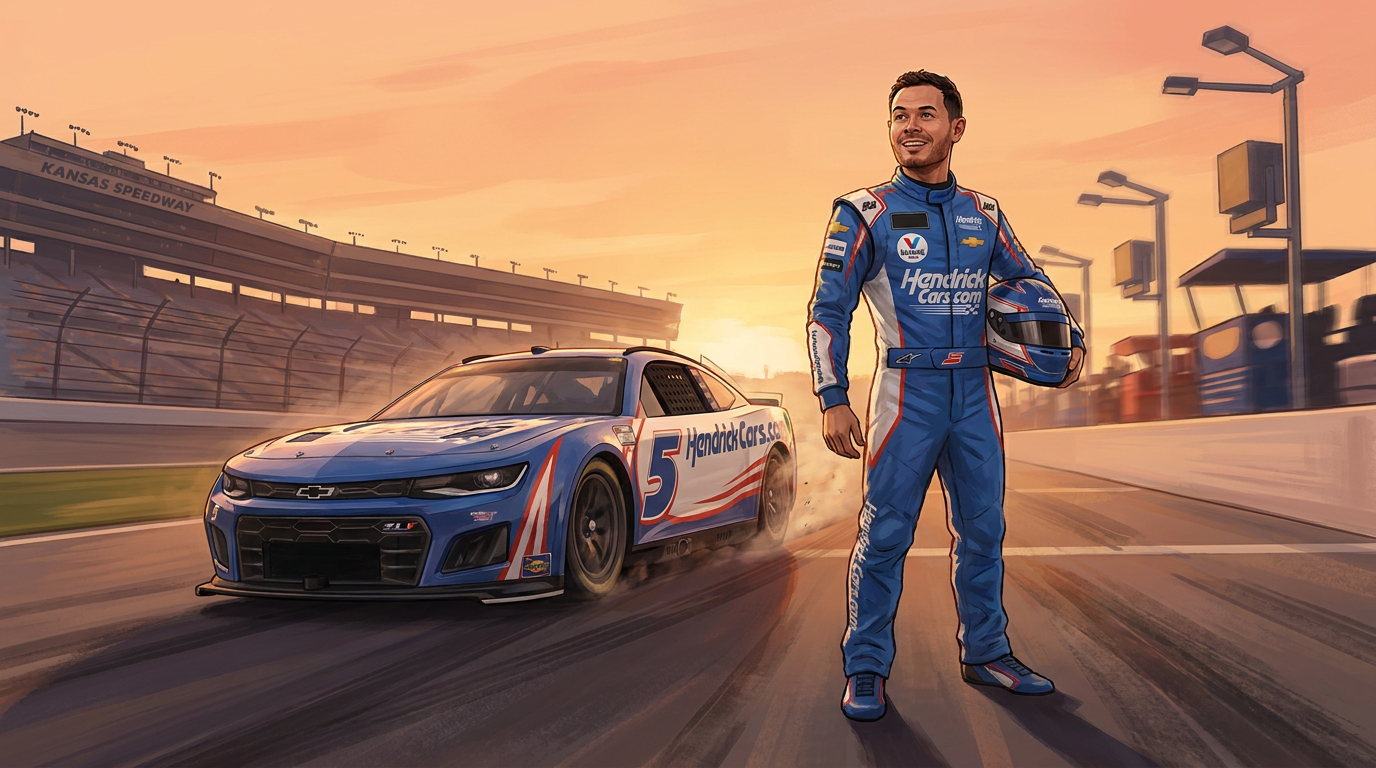

Kyle Larson left Kansas Speedway on September 27 with 76 points, his fourth Cup victory at the track and a 26-point championship lead over Denny Hamlin. The result is in the record book. The engineering story is how the Hendrick Motorsports package gave Larson enough usable pace to pass Chase Briscoe with seven laps remaining.
That late move is significant because Kansas rewards cars that preserve their operating window. Larson needed speed that lasted deep into the final run, rather than a brief surge that faded with tire wear. No verified lap-time, sector or speed-trap figures are available, so the timing of the pass and the points yield provide the soundest basis for analysis.
Late-run pace made the difference
Larson’s pass with seven laps left shows the Hendrick car kept enough balance to attack after the decisive tire cycle developed. The setup gave Larson confidence as grip declined, along with the straight-line performance required to complete the move.
Kansas is a 1.5-mile track, and Larson’s fourth Cup win there adds to the evidence that his team understands its demands in changing conditions. It does not reveal a specific spring, damper or aerodynamic adjustment. The notes include no setup sheet. It does establish repeatability at the same circuit, a meaningful measure of engineering quality.
Larson’s victory was his second in three races.
The results point to a car that performs across different track profiles. His Gateway victory ended a 51-race winless streak and led a Hendrick one-two finish. Kansas called for another type of performance, as sustained momentum and tire management carried greater importance than the braking and traction priorities associated with Gateway.
Tire behavior separated usable pace from peak speed
A late winning pass demonstrates usable pace. It does not establish that Larson had the best peak lap, and the available data provides no exact degradation rates. Briscoe being caught with seven laps remaining does show that the competitive order shifted as the run developed.
Larson’s advantage emerged from the combined tire and aerodynamic platform, rather than qualifying position alone. Rain had prevented the normal qualifying process, leaving teams without that competitive reference. The decisive information came under race fuel loads, where balance migration and tire falloff dictate whether a driver can continue attacking.
Larson’s team collected the maximum points available. Austin Cindric scored 52, while Hamlin earned 51. That 25-point swing between Larson and Hamlin in one race shows the championship value of sustaining performance throughout a run, particularly with points awarded for stage results and finishing position.
Aero stability gave Larson strategic freedom
No verified speed-trap comparison is available for Kansas, so attributing Larson’s win to lower drag or greater downforce would be speculation. The pass supports a tighter conclusion. Larson followed closely enough, managed the tires and placed the car where he could clear Briscoe before the finish.
Those requirements push a setup in competing directions. Additional aerodynamic load can improve corner stability, though it may add drag. A freer car can preserve straight-line speed while making tire wear more difficult to control. Hendrick found an effective compromise that kept Larson in contention until the final seven laps, instead of requiring him to use the car’s performance earlier.
The absence of published sector figures also rules out a reliable account of where Larson gained time. Kansas does not provide the formal sector comparison common in other series, and no verified lap chart in the supplied data measures corner entry, center speed or exit acceleration. The engineering assessment must therefore rest on how the race developed, not invented telemetry.
Fuel and brakes stayed out of the headlines
Fuel saving had become a defined technical issue at Daytona, where Briscoe said the rules package discouraged it. Kansas created a different equation. The notes contain no verified fuel-window figures, pit-stop times or consumption numbers, leaving no basis for crediting an economy advantage.
The same limitation applies to brake management. Kansas puts less emphasis on repeated heavy stopping than some venues, but no temperature or wear data was published in the available material. The operational signal is clear: Larson reached the final seven laps with enough car to attack, rather than managing a documented fuel or brake issue.
That lack of a visible compromise matters. Championship cars score stage points while keeping options open for the finish, and Larson’s 76-point haul shows the team turned race pace into a complete scoring day.
The Johnson comparison requires precision
Larson’s current run has drawn comparisons with peak Jimmie Johnson, who won five consecutive championships from 2006 through 2010 for Hendrick Motorsports. The comparison works at the organizational level, where preparation and adaptability repeatedly deliver points. It is too early as a career judgment.
Johnson’s streak unfolded over five full championship campaigns. Larson, a two-time series champion, leads Hamlin 2,282 points to 2,256, with Christopher Bell third on 2,232. The stronger parallel is technical execution under Chase pressure, rather than an attempt to match their records.
Las Vegas is scheduled for October 1 through October 4, giving Hendrick its next opportunity to show whether the Kansas balance transfers to another 1.5-mile test.