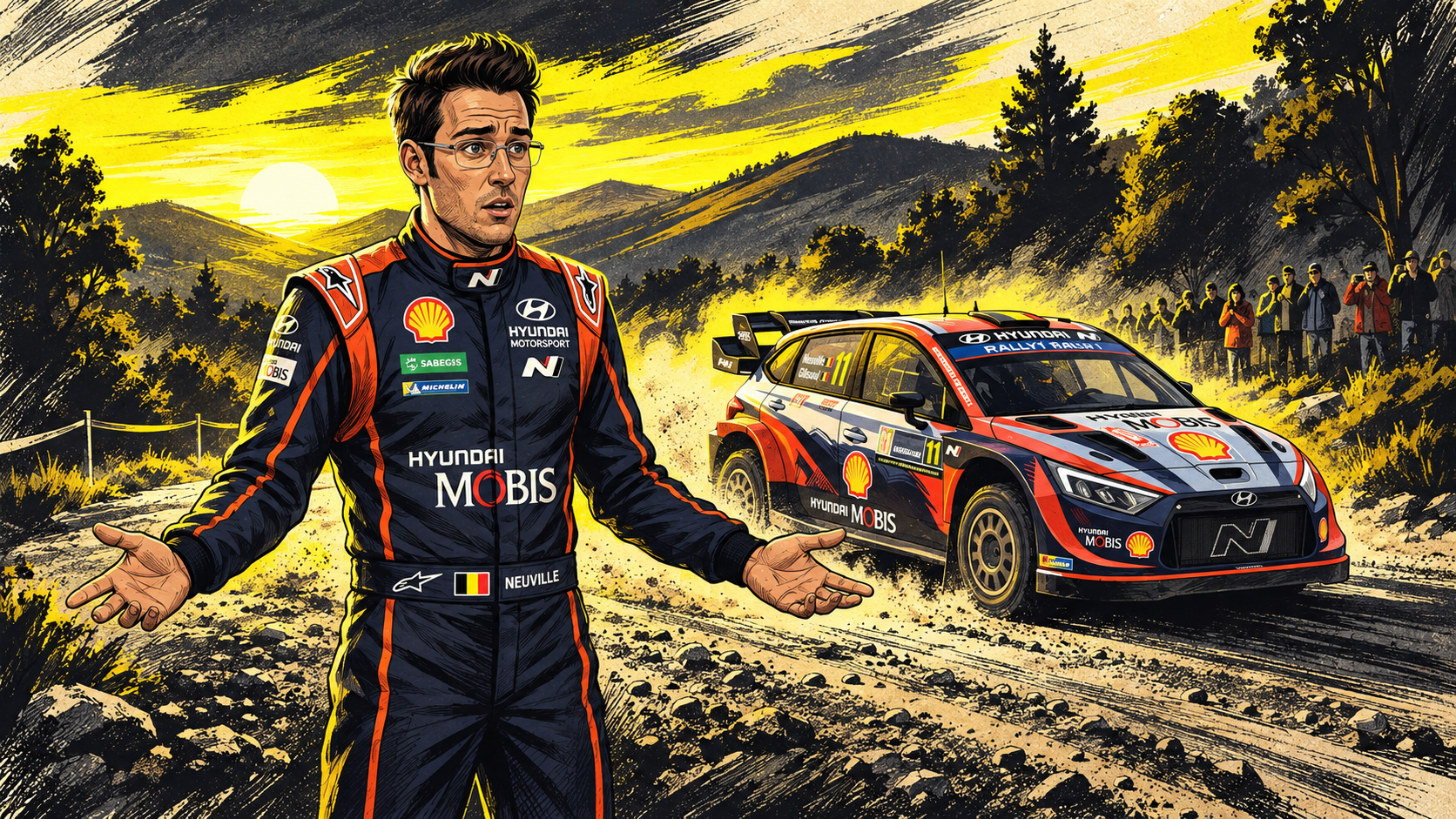
Thierry Neuville is assessing his options for 2027 with his World Rally Championship drive unconfirmed, according to reports published by Autosport and Motorsport.com.
Hyundai remains open to working with him, but the manufacturer’s top-level plans are also unresolved.
That uncertainty reaches far beyond one driver’s contract. Neuville and Hyundai have been central to each other’s WRC programs, yet both arrive at the championship’s regulatory crossroads without a declared route forward. WRC cannot allow that indecision to persist.
Neuville has earned the right to reconsider
Neuville is considering reducing his WRC commitments in 2027. That would be an understandable choice for the Belgian, particularly while the shape of Hyundai’s program remains unsettled.
A driver cannot sensibly judge his future without knowing the machinery, schedule and competitive ambition behind the offer. Neuville should not be expected to make an unconditional commitment simply because continuity would be convenient for his employer or the championship.
Hyundai, equally, should not build its plans around the assumption that Neuville will remain available in the same capacity. If it wants him to lead another campaign, it must provide a credible sporting proposition rather than rely on their shared history.
Hyundai’s car strategy raises harder questions
Hyundai has ruled out developing a completely new car for the 2027 regulations. It has instead produced a revised Rally2-based machine that could potentially compete in WRC’s top category.
Cost control and accessible regulations are necessary if the championship wants more manufacturers. A Rally2-derived route therefore deserves serious consideration. But an adapted car cannot become a substitute for clarity or commitment.
Hyundai must explain what it wants from the next era. Is the revised car intended to support a full championship challenge, serve as a transitional project or preserve a presence while the company considers its longer-term position? Those are materially different objectives for drivers, engineers, rivals and fans. Entering a new rules cycle without defining that ambition would weaken Hyundai before the first stage begins.
The FIA’s timing is part of the problem
Hyundai Motorsport president Cyril Abiteboul told Motorsport.com that the company’s direction would depend partly on sporting regulations due to be ratified by the World Motor Sport Council on October 15.
Manufacturers must accept that regulations cannot be written around one competitor’s preferred business timetable. But the FIA must also recognize that delayed decisions have consequences. Teams cannot finalize technical programs, budgets and driver lineups while essential sporting details remain unsettled.
The governing body should use the October 15 decision to provide a complete framework, not another provisional layer. That framework must explain how different technical concepts will compete, how equivalence will be monitored and how the rules will remain stable enough to justify investment.
Equivalence must be visible and credible
If Rally2-derived cars share the leading category with other designs, WRC needs a transparent method of controlling their performance. The championship cannot afford recurring arguments over whether one route has been favored through weight, power, aerodynamics or another adjustment.
Technical equivalence is never free of controversy, but secrecy makes it worse. The FIA should publish the principles, review schedule and permitted adjustment mechanisms before manufacturers commit. It should also set limits that prevent constant changes from becoming a substitute for sound initial regulations.
Fans do not need every confidential engineering detail. They do need confidence that victories are being decided on the stages rather than through an opaque sequence of regulatory concessions.
WRC needs binding answers
Elfyn Evans and Scott Martin have just secured their first world titles after a 13-rally contest decided by five points, according to WRC.com. Oliver Solberg and Sami Pajari kept three Toyota crews in contention, while Hyundai ended the season facing questions about its car, leading driver and future direction.
That contrast matters. Toyota’s strength cannot be answered by leaving Hyundai’s program in limbo. Once the 2027 regulations are ratified, WRC should impose a firm deadline for manufacturer registrations and require entrants to state whether they are committing to a full campaign.
The priority is not forcing Neuville into a decision. It is giving him, Hyundai and every prospective entrant enough certainty to make one. October 15 must begin that process, because WRC’s next era cannot be built around conditional plans.