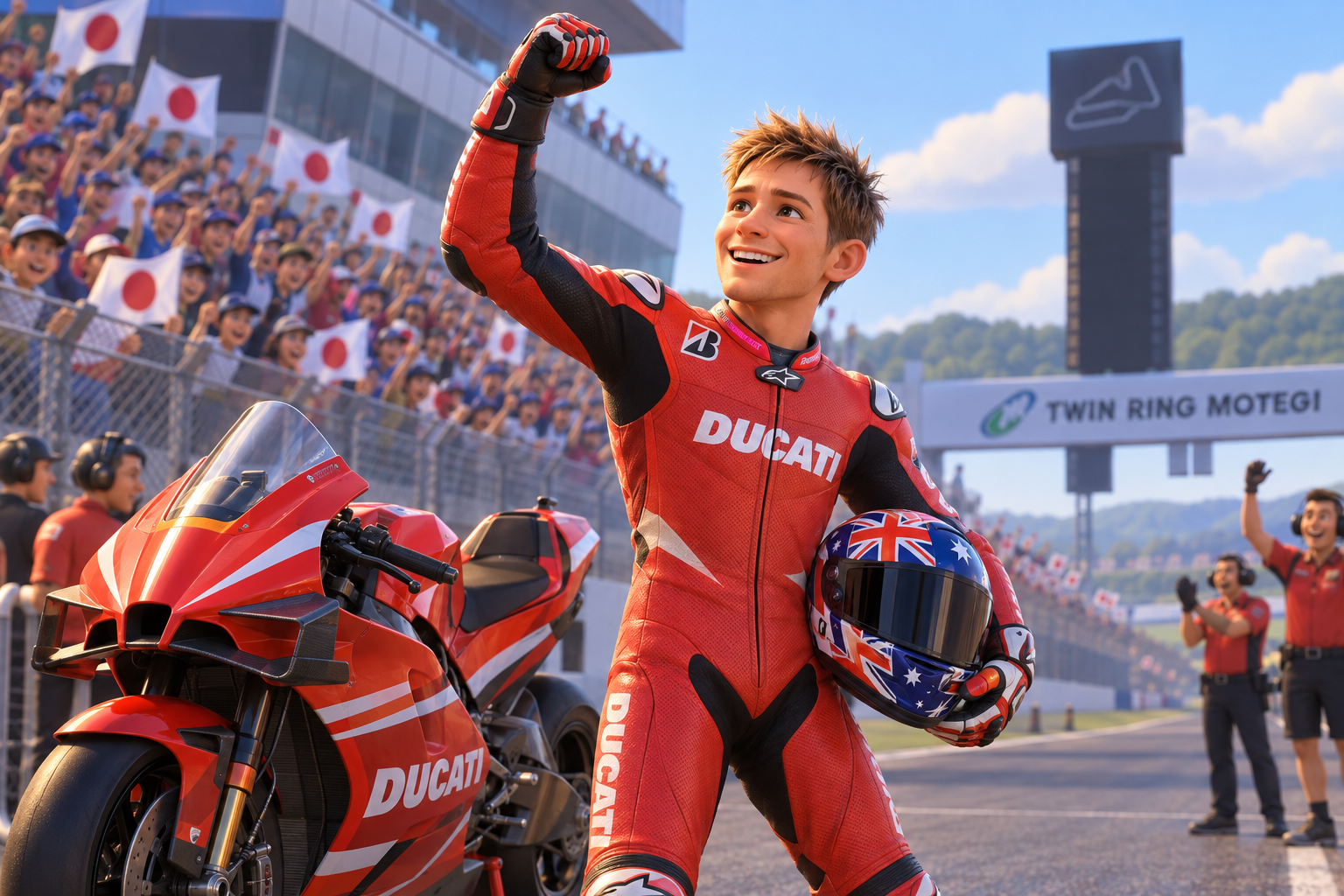
Motegi delivered a technical lesson that mattered more than the finishing order: MotoGP teams cannot continue treating a hard tire’s label as a verdict on its performance.
The Japanese Grand Prix showed how quickly that assumption can mislead the paddock. Michelin introduced its heat-resistant hard rear to cope with the resurfaced Mobility Resort Motegi, and it helped produce Sunday pace that surpassed Saturday’s sprint despite the longer race distance.
The stopwatch settled the argument
Marc Márquez’s average Grand Prix lap was 0.387 seconds faster than his average sprint lap. Enea Bastianini also set a 1:43.041 lap record on Sunday, 0.430 seconds quicker than Márquez’s sprint fastest lap of 1:43.471.
The comparison is not a perfect lab test. Fuel loads, temperatures, race lengths, traffic and setup choices can all differ between Saturday and Sunday. Even so, a faster average pace over the longer race is strong evidence that the hard rear was more than a conservative tire capable of reaching the finish. It also offered serious performance.
Construction mattered more than the label
Describing this as merely a hard-compound success misses the engineering point. Michelin supplied a rear tire with a heat-resistant layer for Motegi’s new asphalt, and it was similar to tires used in Austria and Brazil.
The construction was designed to manage heat at a resurfaced circuit. Heat control affects more than durability. A rear tire that stays within its working window can preserve its profile, stabilize drive grip and provide more repeatable behavior as the laps build.
The result challenges the familiar assumption that a harder option must give up too much initial grip. At Motegi, the important question was not whether the sidewall said hard. It was whether the complete tire suited the thermal demands of the asphalt.
Setup decisions followed the wrong signal
Teams had avoided the heat-resistant hard rear before the Grand Prix. That was significant because tire selection and motorcycle setup are inseparable.
Rear-tire behavior affects load transfer, traction-control calibration, engine-braking choices and how aggressively a rider can accelerate while picking up the bike. When teams discount a tire before gathering representative running, they also give up the opportunity to build a setup around its strengths.
Motegi therefore revealed a process problem rather than a simple selection error. Engineers operate under severe time pressure, but rejecting an unfamiliar construction because of its nominal compound risks allowing expectations to dictate the data program.
Race pace outweighed missing speed-trap detail
The figures do not isolate sector times, speed-trap performance, brake temperatures or fuel consumption, so those factors cannot credibly explain the gain. In any case, the average-lap comparison is more useful than a single peak speed would have been.
A fast lap can result from a brief grip peak. A stronger average over a Grand Prix points to repeatability and degradation control. Bastianini’s record showed the tire’s outright ceiling, while Márquez’s 0.387-second average improvement demonstrated that speed could coexist with sustained race performance.
MotoGP needs a better tire-testing habit
The solution is not a rule requiring riders to use particular compounds. Teams should retain strategic freedom, and Michelin cannot guarantee that every special construction will work equally well on every bike.
MotoGP should, however, encourage a more disciplined evaluation process when a supplier introduces a circuit-specific construction. Teams need meaningful baseline runs before rejecting it, while Michelin must clearly explain how construction and compound interact. A tire name is shorthand, not engineering analysis.
Motegi’s figures support a straightforward verdict: the paddock left performance unused because it feared a label. At future resurfaced venues, teams should start with thermal requirements and measured degradation before choosing the tire. Doing that calculation in reverse is no longer defensible.